The Galapagos Islands are famous for animals that have adapted to life in unusual ways. Giant tortoises, marine iguanas, penguins, sea lions, and blue-footed boobies are some of the wildlife visitors hope to see. But one bird stands out from almost every other seabird in the world.
The Galapagos Cormorant, also called the Flightless Cormorant, is a seabird that cannot fly.
Its scientific name is Phalacrocorax harrisi. It is found only in the Galapagos Islands, mainly around the coasts of Fernandina and Isabela. Unlike most cormorants, this bird has tiny wings and strong legs that help it move through the water. It has adapted so closely to its marine environment that flying is no longer part of its life.
This makes the Galapagos Cormorant one of the most interesting birds you can encounter while exploring the islands.
Key Takeaways
- The Galapagos Cormorant is the only cormorant species that cannot fly.
- It lives only in the Galapagos Islands, mainly around Fernandina and Isabela.
- Its small wings and strong legs make it better suited for underwater hunting than flying.
- It feeds mainly on fish, eels, squid, and octopus.
- Its small population and limited range make conservation and protection of its marine habitat especially important.
What Is a Galapagos Cormorant?
The Galapagos Cormorant is a large seabird that spends much of its time around the rocky coastline. It belongs to the cormorant family, a group of birds known for their ability to dive and catch fish underwater.
The unusual part is that the Galapagos species has lost the ability to fly.
Its wings became much smaller through generations of evolution. Today, the wings are better suited to helping the bird move underwater than carrying it through the air. Its legs and feet do most of the work when it dives and swims.
This is an example of how animals can change when they live in a particular environment for a very long time.
The Galapagos Islands provided conditions where being an excellent swimmer and diver could be more useful than being able to fly long distances. With plenty of food in the surrounding ocean, the birds became highly adapted to life along the coast.
Galapagos Cormorant at a Glance
| Information | Details |
| Common Name | Galapagos Cormorant / Flightless Cormorant |
| Scientific Name | Phalacrocorax harrisi |
| Found In | Galapagos Islands, Ecuador |
| Main Islands | Fernandina and Isabela |
| Can It Fly? | No |
| Main Food | Fish, eels, squid, and octopus |
| Main Skill | Diving and swimming |
| Appearance | Dark body, short wings, strong legs |
| Eye Color | Bright turquoise |
| Breeding Season | Mainly July to October |
| Eggs | Usually around 3 eggs |
| Population | About 2,085 individuals in a 2022 count |
| Conservation Status | Vulnerable |
| Main Threats | Food shortages, changing ocean conditions, El Niño, and introduced species |
| Best Places to See | Punta Espinosa and Urbina Bay |
| Interesting Fact | It is the only cormorant species that cannot fly |
Where Does the Galapagos Cormorant Live?
The Galapagos Cormorant has one of the smallest ranges of any seabird in the Galapagos.
It is mainly found around Fernandina Island and the western and northern coastal areas of Isabela Island. These areas have cold, nutrient-rich waters that provide good feeding conditions for marine wildlife.
Fernandina is especially important because its surrounding waters are influenced by cold ocean currents that bring nutrients toward the surface. These waters support a large amount of marine life, giving cormorants access to the food they need.
One place where visitors may have a chance to see these birds is Punta Espinosa on Fernandina Island. Flightless cormorants can be seen along the coast, often close to rocks and the water.
On Isabela, Urbina Bay is another visitor site where flightless cormorants may be observed near the coast.
Why Can’t the Galapagos Cormorant Fly?
This is probably the first question most people have when they hear about this bird.
The short answer is evolution.
Flying requires a lot of energy. Birds that fly need wings and muscles capable of supporting their bodies in the air. But the Galapagos Cormorant developed a different lifestyle.
Instead of using its wings to travel through the sky, it spends much of its time searching for food underwater. Its wings are small, while its legs and feet are strong.
Over many generations, natural selection favored birds that were well suited to their surroundings. The result is a cormorant that is an excellent diver but cannot fly. Its wings are sometimes described as being more like small fins because they help with movement underwater.
There is an important lesson here. Being unable to fly is not necessarily a disadvantage when an animal lives in an environment where other skills are more useful.
What Does the Galapagos Cormorant Eat?
The Galapagos Cormorant is a skilled underwater hunter.
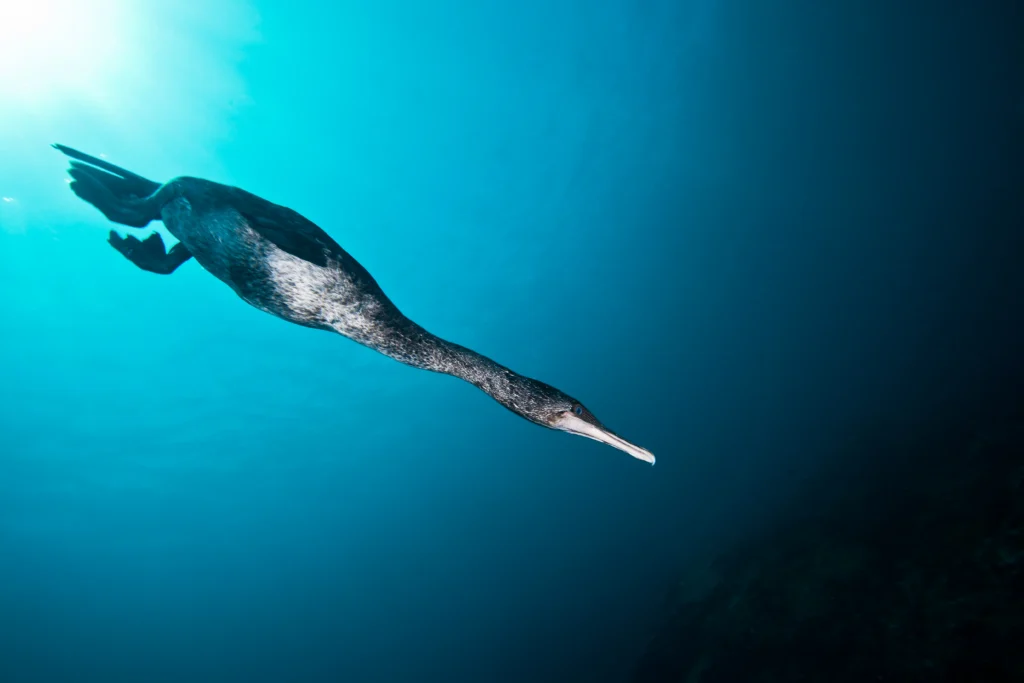
Its diet includes fish, eels, squid, and octopuses. The bird dives into the ocean and uses its feet and body to move underwater while searching for prey.
The waters around Fernandina and western Isabela are particularly productive because of their nutrient-rich conditions. This helps support the marine animals that cormorants depend on.
Watching one hunt can be quite different from watching a flying seabird. Instead of searching for food from the air, the cormorant gets into the water and disappears below the surface.
It may then return to the rocks after feeding, where it can rest and dry its feathers.
What Does a Galapagos Cormorant Look Like?
The Galapagos Cormorant has a distinctive appearance.
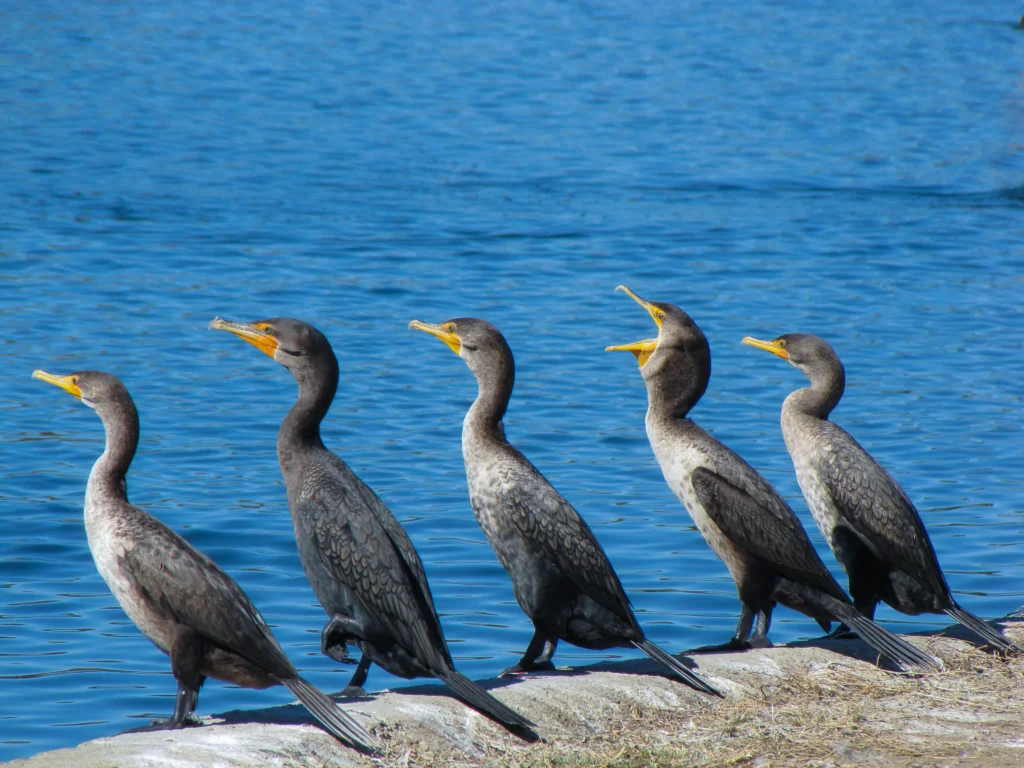
It has a dark brown to blackish body, strong legs, and a long bill. One of its most noticeable features is its bright turquoise-colored eyes. These eyes can look especially striking against its darker feathers.
Its small wings are also easy to notice. When compared with other cormorants, the wings look unusually short.
The bird has a fairly solid body because it is built for swimming and diving rather than flying. Its strong feet help it move underwater while searching for prey.
After spending time in the ocean, cormorants can often be seen sitting on rocks along the shoreline.
How Does the Galapagos Cormorant Behave?
These birds are active around the water and can often be seen resting together on coastal rocks.
After a dive, a cormorant may return to land and spend time resting and drying its feathers. They can also be social, with several birds gathering in the same coastal area.
Their behavior makes sense when you consider how they live. They spend a large part of their day moving between the ocean, where they find food, and rocky coastal areas, where they rest and breed.
Because they cannot fly, they generally remain closely connected to the coastline and nearby marine environment.
Breeding and Nesting
The breeding behavior of the Galapagos Cormorant is another interesting part of its life.
The main nesting period usually occurs during the cooler months, particularly from July through October. This period also tends to provide good marine feeding conditions.
A female usually lays around three eggs in a clutch, although not every chick survives.
Both parents take part in incubation and caring for the young. They share responsibilities such as protecting the nest and bringing food to their chicks.
One unusual part of their breeding behavior is what happens later in the nesting cycle. After the young become more independent, the female may leave and form a new pair, while the male continues caring for the remaining chicks. Females can potentially breed more than once in a year.
Nesting usually takes place in sheltered coastal areas, generally close to the sea.
How Many Galapagos Cormorants Are There?
The Galapagos Cormorant has a relatively small population.
A 2022 count by the Galapagos National Park Directorate estimated approximately 2,085 individuals. The species is classified as Vulnerable.
Population numbers can change because the birds depend heavily on the condition of the surrounding marine environment.
One important factor is El Niño. Changes in ocean temperatures can affect the availability of fish and other marine prey. When food becomes harder to find, species that depend on the ocean can experience pressure.
This is one reason scientists continue to monitor Galapagos Cormorants and other marine species.
What Threats Does the Galapagos Cormorant Face?
The Galapagos Cormorant has adapted remarkably well to its environment, but it still faces several threats.
Because the bird cannot fly, it has limited ability to move from one island to another. This makes its small geographic range particularly important. Changes in the areas where it lives can have a direct effect on the population.
Introduced animals can also create problems for native Galapagos wildlife. Potential predators and invasive species are among the concerns for flightless cormorants.
Changes in ocean conditions are another concern. Events such as El Niño can reduce the amount of food available in the waters where these birds hunt. Climate change may add further pressure by changing marine conditions over time.
The health of the cormorant population is therefore closely connected to the health of the ocean around the islands.
Why Is the Galapagos Cormorant Important?
The Galapagos Cormorant is important because it represents the unique evolutionary history of the islands.
The Galapagos are known for species that evolved differently from their relatives elsewhere, and the flightless cormorant is one of the clearest examples.
It also provides scientists with useful information about the marine environment. Because the bird depends on coastal waters for food, changes in its population and behavior can provide clues about changes in the surrounding ecosystem.
Protecting the cormorant therefore means protecting more than just one bird species. It also means protecting the coastal habitats and marine food systems that support it.
Where Can You See a Galapagos Cormorant?
Visitors may have opportunities to see Galapagos Cormorants on Fernandina and Isabela Islands.
Punta Espinosa on Fernandina is one of the notable visitor sites for seeing them. The birds can often be found along the rocky coastline. Urbina Bay on Isabela is another location where visitors may encounter them.
Sightings are still wildlife encounters, so there is no guarantee that a bird will appear at a particular time.
If you do see one, it is worth taking a moment to watch its behavior rather than simply taking a photograph. You may see it swimming, diving for food, resting on rocks, or interacting with another cormorant.
FAQs About Galapagos Cormorant
Is the Galapagos Cormorant dangerous?
No. Galapagos Cormorants are wild animals but are not considered dangerous to people. Visitors should still keep a respectful distance.
How long can a Galapagos Cormorant stay underwater?
The bird can make extended underwater dives while searching for food. The exact time varies depending on its activity and conditions.
How fast can a Galapagos Cormorant swim?
There is no commonly established speed that accurately describes the species. Its body and feet are adapted for efficient underwater movement.
Do the Galapagos Cormorants have predators?
Yes. Eggs and young birds can be vulnerable to predators, including introduced animals and native species in some circumstances.
How long do Galapagos Cormorants live?
A precise average lifespan is not well established, but researchers continue to study the species because of its small population and restricted range.
Do Galapagos Cormorants migrate?
No. They are generally resident birds and stay close to the islands where they live and feed.
How big is a Galapagos Cormorant?
It is a relatively large cormorant, with a sturdy body adapted for swimming and diving rather than flight.
Can baby Galapagos Cormorants fly?
No. Young birds develop the same flightless characteristics as adults. They learn to swim and hunt instead of learning to fly.
How deep can a Galapagos Cormorant dive?
They are capable divers that search underwater for prey, although their exact diving depth can vary depending on food availability and conditions.
What makes the Galapagos Cormorant different from other cormorants?
Its most important difference is its inability to fly. Unlike other cormorants, it has very small wings and relies heavily on its strong legs and feet for underwater movement.
A Bird Found Nowhere Else
The Galapagos Cormorant is more than a bird that cannot fly. It is an example of how life can adapt to very specific conditions.
Its small wings, powerful legs, diving ability, coastal lifestyle, and restricted range all tell part of the story of evolution in the Galapagos Islands.
For travelers, seeing one can be a memorable part of a Galapagos trip. For scientists and conservationists, the species provides an important window into the health of the islands and surrounding ocean.
The bird may look unusual at first, but its unusual features are exactly what make it so well suited to its home. In a place as remarkable as the Galapagos, the flightless cormorant is a perfect example of how nature can take a familiar animal and shape it into something completely different.
If you are exploring the Galapagos Islands, keep an eye on the rocky coastline around Fernandina and Isabela. You may spot a dark-feathered bird with bright turquoise eyes sitting beside the sea. It may not take flight, but watching it disappear beneath the water can be just as impressive.