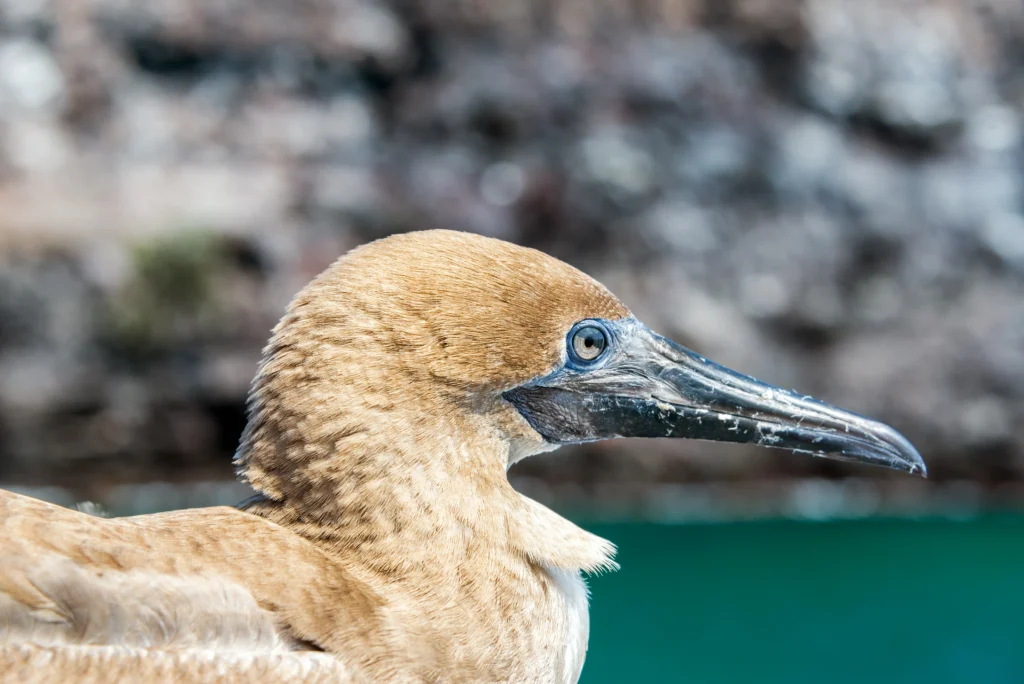
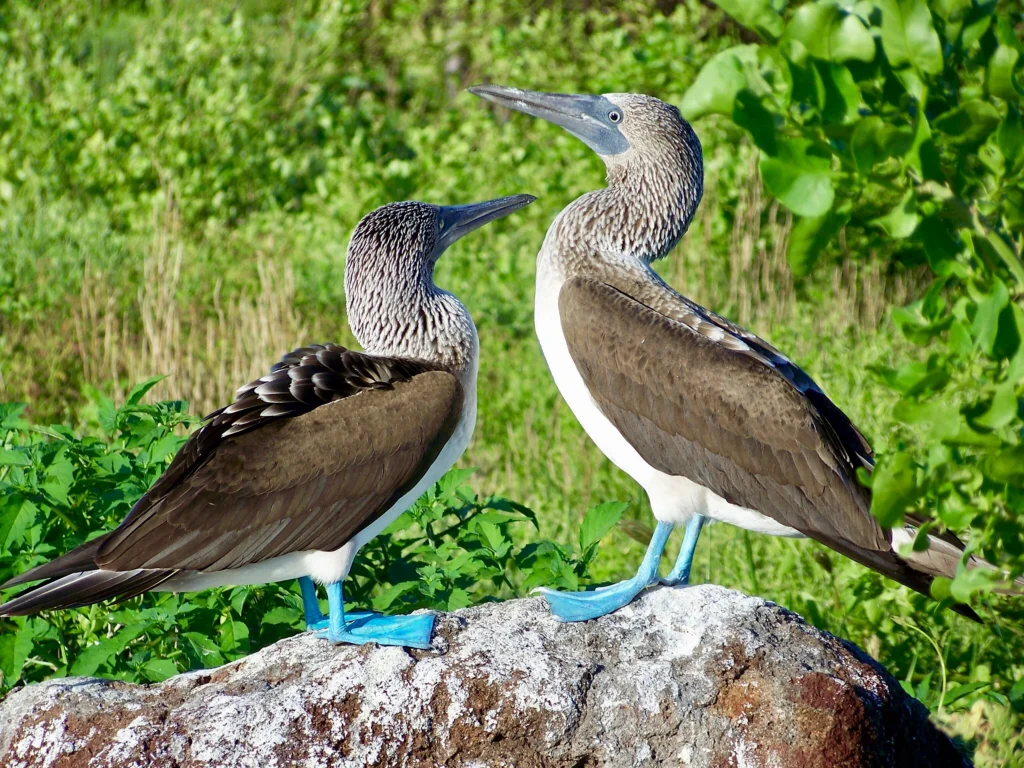
The blue-footed booby is one of the most recognizable seabirds in the world. Its bright blue feet, long pointed bill, white and brown body, and dramatic diving behavior make it especially popular with birdwatchers and wildlife travelers.
Its scientific name is Sula nebouxii. The species belongs to the booby family, Sulidae, and is closely related to other boobies and gannets. In the Galapagos Islands, the blue-footed booby is one of the three booby species found across the archipelago. The other two are the Nazca booby and red-footed booby.
Blue-footed boobies spend much of their lives around the ocean, where they hunt fish by diving from the air into the water. On land, they nest on the ground and can often be observed walking around their colonies.
Here is a complete guide to the blue-footed booby, including its appearance, habitat, diet, behavior, breeding, blue feet, predators, conservation, and where you can see these remarkable birds.
Key Takeaways
- The blue-footed booby is a distinctive Pacific seabird best known for its bright blue webbed feet and unique courtship displays.
- It mainly eats fish and uses plunge diving to catch prey from the ocean.
- Blue-footed boobies usually nest on the ground and can lay one to three eggs under favorable conditions.
- Food availability and changing ocean conditions can have a major effect on their breeding success and population.
- The Galapagos Islands offer excellent opportunities to observe blue-footed boobies in their natural habitat while following protected-area and wildlife guidelines.
What Is a Blue-footed Booby?
The blue-footed booby is a marine bird that lives along the Pacific coast of the Americas and on offshore islands. It is particularly famous for its striking blue feet.
The word “booby” comes from an old Spanish term associated with foolish or unwary behavior. Historically, these birds were considered relatively easy for people to approach.
Despite their somewhat unusual name, blue-footed boobies are highly specialized seabirds. Their bodies, wings, bills, and feet are adapted to life around the ocean.
They are excellent divers and spend much of their time searching for fish in coastal and offshore waters.
What Does a Blue-footed Booby Look Like?
The most obvious feature is its bright blue feet.
Adults have a combination of white, brown, gray, and blue coloring. Their head and upper body have brownish tones, while much of the underside is white.
They have:
- Bright blue webbed feet
- Long, pointed wings
- A long, pointed bill
- Pale facial coloring
- Brown upperparts
- White underparts
- A streamlined body
Their body shape allows them to fly efficiently over the ocean and make fast dives into the water.
The blue feet are especially noticeable when the birds are standing, walking, displaying, or nesting.
Why Are Blue-footed Boobies’ Feet Blue?
The blue color of their feet comes from pigments and structural characteristics associated with the skin and underlying tissues.
The intensity of the blue coloration can vary. In general, brighter blue feet are particularly noticeable during courtship.
The feet are not simply decorative. Like the feet of other seabirds, they are useful for walking on land, positioning themselves at nesting sites, and interacting with mates and chicks.
The color also plays an important role in courtship behavior.
Why Do Blue-footed Boobies Have Blue Feet?
One of the most interesting features of this species is the connection between blue feet and reproduction.
During courtship, a male may lift and display his feet as part of an elaborate series of movements. The pair may also perform coordinated displays involving their heads, wings, and bills.
The blue feet therefore become an important visual feature during courtship.
This is one reason visitors to the Galapagos often find blue-footed boobies particularly entertaining to watch. Their courtship behavior can include exaggerated movements that look almost like a dance.
Where Do Blue-footed Boobies Live?
Blue-footed boobies are found along parts of the Pacific coast of North and South America and on several offshore islands.
The Galapagos Islands are one of the best-known places to see them.
Within the Galapagos, the species breeds on many islands, although its distribution is not uniform. The Charles Darwin Foundation’s Galapagos Species Database records the Galapagos subspecies as Sula nebouxii excisa and describes it as breeding on most islands except those north of the equator, with occasional breeding on Genovesa.
Their choice of habitat is closely linked to access to productive marine feeding areas.
Blue-footed Booby Habitat
Blue-footed boobies generally use coastal habitats, rocky shorelines, islands, and areas close to productive ocean waters.
Unlike many birds that build nests in trees, blue-footed boobies normally nest directly on the ground.
Their nesting areas may look surprisingly simple. A nest can be little more than a cleared area on the ground surrounded by rocks or other natural features.
This ground-nesting behavior makes the birds easy to observe but can also leave eggs and chicks exposed to environmental conditions and predators.
What Do Blue-footed Boobies Eat?
Blue-footed boobies are carnivores that primarily eat fish.
Their diet can include small schooling fish and other marine prey depending on what is available in the surrounding waters.
In the Galapagos, food availability has an important relationship with breeding success. Galapagos Conservancy notes that blue-footed boobies generally feed relatively close to shore compared with Nazca and red-footed boobies.
This difference in feeding range is also associated with differences in reproductive strategy among the three Galapagos booby species.
How Do Blue-footed Boobies Catch Fish?
Blue-footed boobies are famous for plunge diving.
A bird searches for prey while flying above the ocean. When it spots a potential target, it can rapidly descend toward the water and dive into the sea.
The bird folds its wings and enters the water at high speed.
It can then pursue or grab fish before returning to the surface.
This hunting strategy allows blue-footed boobies to take advantage of fish that are swimming near the surface.
Galapagos Conservancy describes the three Galapagos booby species as plunge divers that catch fish during their dives.
How Deep Can a Blue-footed Booby Dive?
Blue-footed boobies are capable divers, but the exact diving depth can vary depending on the situation and available prey.
They do not need to make extremely deep dives for every meal. Their hunting strategy often focuses on fish that can be reached from the surface.
Their streamlined body and strong wings help them transition quickly from flight to underwater movement.
Do Blue-footed Boobies Fly?
Yes. Blue-footed boobies are strong flyers.
They use powerful wingbeats followed by gliding when traveling over the ocean. Their long wings allow them to cover considerable distances while searching for food.
They may spend hours moving between nesting areas and feeding grounds.
Their ability to fly, dive, swim, and walk gives them several ways to move through their coastal environment.
Blue-footed Booby Breeding
Blue-footed boobies usually breed in colonies or loose groups.
Courtship begins with visual displays between males and females. The famous foot-lifting display is one of the most recognizable behaviors.
After pairing, the birds establish a nesting area on the ground.
The female may lay multiple eggs. Galapagos Conservancy reports that blue-footed boobies can lay between one and three eggs, and when food conditions are favorable, multiple chicks may successfully reach the fledging stage.
How Do Blue-footed Boobies Choose a Mate?
Courtship involves several behaviors.
A male may:
- Lift one foot at a time
- Show his blue feet
- Point his bill upward
- Spread or move his wings
- Walk around the female
- Make calls or other vocalizations
The female also participates in the courtship process.
The blue feet are particularly important because they provide a visible signal during the display.
How Many Eggs Does a Blue-footed Booby Lay?
A blue-footed booby can lay one to three eggs.
The number of eggs and the success of the breeding attempt can depend heavily on food availability and environmental conditions.
In productive years, parents may have enough food to successfully raise more than one chick.
This is an important difference from the breeding strategy of some other Galapagos boobies.
How Do Blue-footed Boobies Care for Their Eggs?
Both parents can participate in incubation and caring for the young.
One interesting adaptation is the use of their feet to help incubate the eggs.
Instead of relying only on body feathers, the birds can place their warm feet over the eggs.
After hatching, both parents can participate in feeding and protecting their offspring.
What Do Baby Blue-footed Boobies Look Like?
Blue-footed booby chicks look very different from adults.
Young chicks are covered in soft, pale down feathers and have a fluffy appearance.
As they grow, their appearance gradually changes and their adult feathers develop.
Their feet also become more recognizable as they mature.
Young birds eventually learn the skills needed for flight and fishing before becoming independent.
How Long Do Blue-footed Boobies Live?
The lifespan of a blue-footed booby can vary depending on environmental conditions, food availability, predation, disease, and other factors.
Like many wild seabirds, their survival depends heavily on access to reliable food sources.
Scientists continue to study the population dynamics and breeding patterns of blue-footed boobies, particularly in the Galapagos.
Blue-footed Booby vs Nazca Booby
The blue-footed booby and Nazca booby are both found in the Galapagos, but they have several differences.
Blue-footed boobies have distinctive blue feet and commonly feed relatively close to shore.
Nazca boobies are larger and generally forage farther offshore.
Their reproductive strategies also differ. Galapagos Conservancy notes that Nazca boobies usually lay two eggs, but typically only one chick survives because of sibling competition. Blue-footed boobies can lay one to three eggs and may successfully raise multiple chicks when conditions are favorable.
Blue-footed Booby vs Red-footed Booby
The red-footed booby is another booby species found in the Galapagos.
The difference in foot color makes identification relatively easy.
Blue-footed boobies have blue feet, while red-footed boobies have red feet.
Their nesting behavior is also different. Blue-footed boobies generally nest on the ground, while red-footed boobies nest in trees and shrubs.
Red-footed boobies also spend more time feeding far out over the open ocean. Galapagos Conservancy describes them as the most abundant of the three Galapagos booby species, even though they can be less frequently encountered by visitors because of their more offshore lifestyle.
Where Can You See Blue-footed Boobies in the Galapagos?
The Galapagos Islands are one of the most famous destinations for seeing blue-footed boobies in the wild.
One notable location is Española Island, where visitors can encounter nesting colonies of blue-footed and Nazca boobies along visitor trails.
Depending on the itinerary, visitors may also encounter blue-footed boobies on other islands and coastal sites.
Because wildlife movements and access conditions can vary, visitors should follow the current guidance of the Galapagos National Park and their licensed guides.
When Is the Best Time to See Blue-footed Boobies?
Blue-footed boobies can be encountered in the Galapagos throughout the year.
However, wildlife activity can vary depending on food availability, breeding activity, weather, and location.
If your primary goal is to observe courtship or nesting behavior, ask your naturalist guide about current wildlife activity and the best visitor sites during your trip.
The most important thing is not to approach nesting birds beyond permitted visitor distances.
Are Blue-footed Boobies Endangered?
The conservation status of a species can vary depending on the assessment and population being considered, so current authoritative sources should be checked when discussing its status.
The Galapagos subspecies is tracked in the Charles Darwin Foundation’s species database, which identifies its ecological role as piscivorous and its Galapagos distribution.
Historically, researchers have documented significant changes in blue-footed booby numbers and breeding activity in the Galapagos. Long-term research has connected periods of poor reproduction with changes in marine food availability, including the availability of sardines.
This highlights an important point about seabird conservation: protecting the birds also requires understanding and protecting the marine ecosystem that supplies their food.
What Threats Do Blue-footed Boobies Face?
Blue-footed boobies depend strongly on healthy marine ecosystems.
Potential threats can include:
- Changes in fish availability
- Climate variability
- El Niño events
- Changes in ocean productivity
- Human disturbance
- Marine pollution
- Interactions with fisheries
Food availability is particularly important because seabirds need enough prey not only to survive but also to reproduce successfully.
Past research in the Galapagos has shown how major changes in marine conditions can affect blue-footed booby reproduction.
Why Are Blue-footed Boobies Important to the Galapagos?
Blue-footed boobies are an important part of the Galapagos marine ecosystem.
They connect land and sea through their feeding and nesting activities. Their presence also provides scientists with valuable information about marine food availability and environmental conditions.
They are also an important part of the natural experience that makes the Galapagos unique.
The islands support three booby species, each with different feeding and nesting strategies. Together, these birds demonstrate how closely wildlife behavior can be connected to the surrounding marine environment.
Interesting Blue-footed Booby Facts
Here are some quick facts about these remarkable birds:
- Their scientific name is Sula nebouxii.
- Their most famous feature is their bright blue feet.
- They are excellent plunge divers.
- They primarily eat fish.
- They generally nest on the ground.
- They can lay one to three eggs in the Galapagos.
- Both parents can participate in raising chicks.
- Blue feet play an important role in courtship.
- They are closely associated with the Pacific coast and offshore islands.
- The Galapagos is one of the best-known places to observe them.
- Española Island is one location where visitors can see nesting blue-footed boobies.
- They share the Galapagos with Nazca and red-footed boobies.
How to Watch Blue-footed Boobies Responsibly
Seeing a blue-footed booby in the wild can be an unforgettable experience, but wildlife should always be observed responsibly.
Stay on designated trails and follow the instructions of your guide. Do not touch, feed, chase, or deliberately disturb the birds.
Avoid approaching nests or chicks. Even if a bird appears comfortable around people, maintaining the required distance helps reduce stress and disturbance.
Do not use flash photography if it is prohibited by local guidelines, and avoid blocking a bird’s path.
Responsible tourism is particularly important in the Galapagos because the islands contain fragile ecosystems and unique wildlife.
The Charles Darwin Foundation emphasizes that visiting the Galapagos is both a privilege and a responsibility and encourages visitors to choose sustainable tourism practices.
FAQs About Blue-Footer Booby
Can blue-footed boobies swim?
Yes. Blue-footed boobies can swim and use their webbed feet to move through the water, although they spend much of their time flying, diving, and hunting for fish.
Are blue-footed boobies friendly to humans?
They are wild birds and should not be treated as pets or approached closely. In places such as the Galapagos, they may appear comfortable around people because they are accustomed to seeing visitors, but visitors should still maintain the required distance.
Can blue-footed boobies fly long distances?
Yes. They are capable of flying considerable distances over the ocean while searching for food. Their long wings allow them to combine powered flight with gliding.
Do blue-footed boobies mate for life?
Blue-footed boobies can form breeding pairs, but it is not accurate to assume that every pair remains together for life. Their pair bonds are associated with breeding and can change over time.
Do blue-footed boobies make loud sounds?
Yes. They use different vocalizations and visual displays to communicate. Males and females can produce calls during courtship, nesting, and interactions with other birds.
Can blue-footed boobies see underwater?
Their eyes are adapted for hunting in and around the water. Their vision helps them locate prey before entering the water and pursue fish during a dive.
Why are they called boobies?
The name “booby” comes from an old Spanish term associated with foolish or unwary behavior. The name was historically linked to the birds being relatively easy for people to approach.
Do blue-footed boobies migrate?
They can travel between feeding and breeding areas, but they are not generally considered long-distance migratory birds in the same way as some other seabird species.
Are blue-footed boobies found outside the Galapagos?
Yes. They are also found along parts of the Pacific coast of the Americas and on offshore islands. The Galapagos is one of the best-known places to observe them.
What should I bring when visiting blue-footed boobies in the Galapagos?
Binoculars, a camera with a suitable zoom lens, sun protection, comfortable walking shoes, and reusable water bottles can be useful. Follow the requirements and recommendations provided by your tour operator and Galapagos National Park authorities.
Conclusion
The blue-footed booby is much more than a bird with unusual blue feet. Its remarkable diving ability, ground-nesting behavior, courtship displays, and close relationship with the ocean make it one of the most fascinating seabirds in the Pacific.
The Galapagos Islands offer one of the most memorable opportunities to see blue-footed boobies in their natural environment. If you want to see these birds, along with giant tortoises, marine iguanas, sea lions, and other unique wildlife, you can visit the Galapagos Islands and explore their protected visitor sites with a licensed naturalist guide.
A trip to the Galapagos can provide a close look at blue-footed boobies while also giving visitors a better understanding of why protecting the islands and surrounding marine ecosystem matters.