The Galapagos penguin is one of the most unusual penguins in the world. It is small, fast in the water, and perfectly adapted to life around the warm equator. Unlike most penguins, which are associated with cold Antarctic or subantarctic environments, the Galapagos penguin lives in the Galapagos Islands, where temperatures can be surprisingly warm.
Its ability to survive in such a different environment is closely connected to the cold ocean currents that reach the islands. These currents bring nutrient-rich water and create feeding opportunities for penguins, even in a tropical setting.
The Galapagos penguin is also one of the rarest penguin species in the world. Its small population, restricted range, and sensitivity to changes in food availability make it an important species to understand and protect.
Key Takeaways
- The Galapagos penguin is the only penguin species that naturally lives north of the equator, surviving in a tropical region because of cold, nutrient-rich ocean currents.
- Cold ocean water is essential to its survival, providing the small fish and other marine prey that make up much of its diet.
- Galapagos penguins are adapted to tropical heat, using cool water, shade, rocky crevices, and behavioral changes to avoid overheating.
- Their small population makes them vulnerable to environmental changes, especially fluctuations in ocean temperature and food availability during events such as El Niño.
- Protecting the penguin also means protecting its marine habitat, maintaining healthy prey populations and reducing disturbance around important nesting areas.
What Is a Galapagos Penguin?
The Galapagos penguin is a small penguin species found almost entirely around the Galapagos Islands of Ecuador. Its scientific name is Spheniscus mendiculus, and it belongs to the same general group as the Humboldt, Magellanic, and African penguins.
It is the only penguin species that naturally lives north of the equator.
Most Galapagos penguins are found around the western islands, particularly areas influenced by the cold Cromwell Current. The waters around Fernandina and Isabela provide some of the most suitable conditions for the species.
Although the islands are located close to the equator, the surrounding ocean can be much cooler than the tropical climate on land. This gives the penguins access to the cold water and abundant marine life they need to survive.
What Does a Galapagos Penguin Look Like?
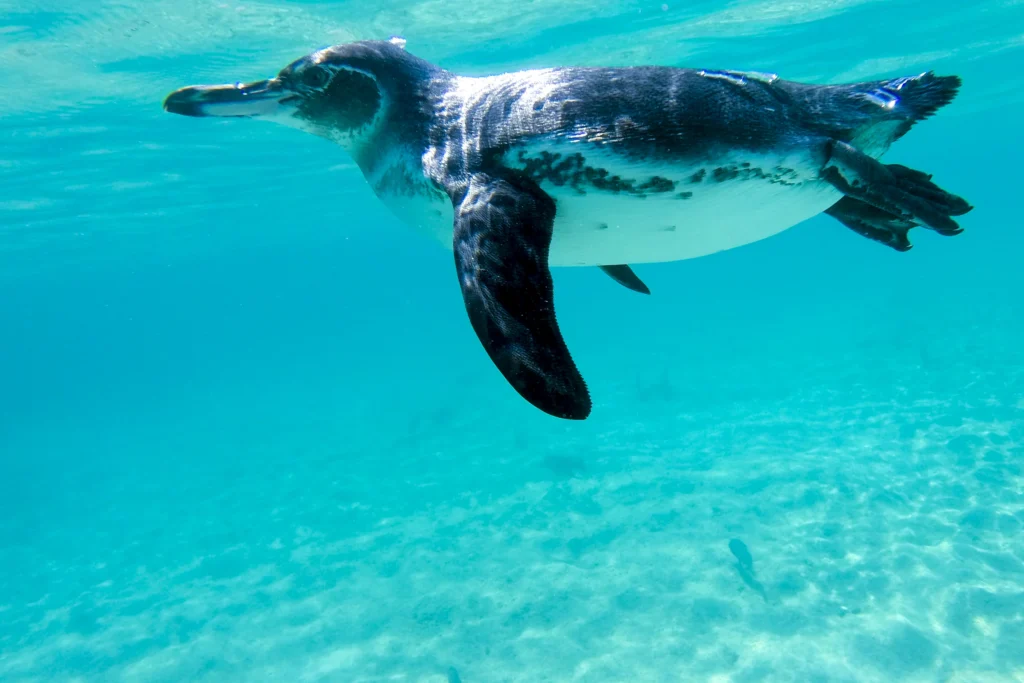
Galapagos penguins are among the smallest penguins, with a compact body that is well suited to swimming.
An adult typically has:
- A black back and head
- A white chest and belly
- A narrow white stripe that curves around the face and throat
- Dark flippers
- A dark, slender bill
- Pinkish areas around the eyes and base of the bill
Their bodies are streamlined, helping them move efficiently through the water while hunting.
Like other penguins, Galapagos penguins have wings that have evolved into stiff flippers. They cannot fly through the air, but these flippers make them excellent underwater swimmers.
Their feathers also provide insulation and help maintain body temperature while they spend much of their time in the ocean.
How Big Is a Galapagos Penguin?
The Galapagos penguin is relatively small compared with many other penguin species.
Adults generally stand around 49 centimeters tall and weigh roughly 2 to 2.5 kilograms, although weight can change depending on food availability, breeding condition, and the time of year.
Their small size may be useful in the Galapagos environment because it reduces the amount of energy required to maintain their bodies.
However, living in a warm climate also creates a challenge. Penguins are built for insulation, which can make overheating a serious concern when they are on land.
Where Do Galapagos Penguins Live?
Galapagos penguins live around the Galapagos archipelago, which lies roughly 1,000 kilometers off the coast of Ecuador.
They are particularly associated with the western islands, where cold, productive waters provide better feeding conditions.
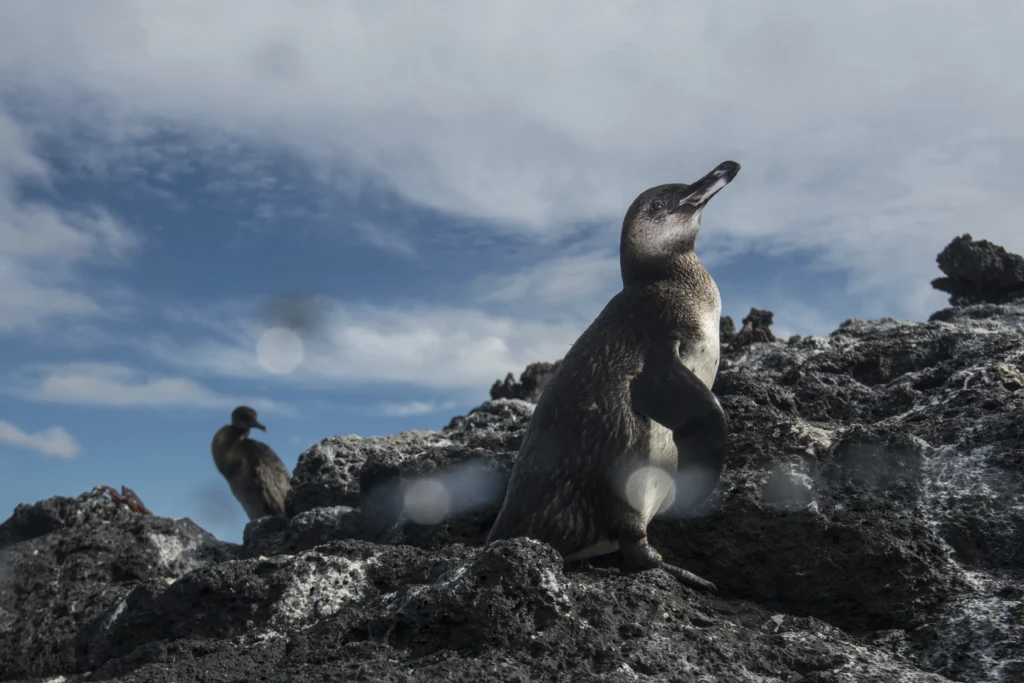
Rocky shorelines, lava formations, cracks, caves, and sheltered spaces can provide places for penguins to rest and raise their young.
The landscape of the Galapagos is very different from the snowy environments many people imagine when they hear the word “penguin.” Instead of ice and snow, these penguins may be seen standing on dark volcanic rocks surrounded by warm air and bright sunlight.
The ocean, rather than the land climate, is the key to their survival.
Why Are There Penguins Near the Equator?
This is one of the most interesting things about the species.
The Galapagos Islands are located directly around the equator, but powerful ocean currents bring cooler water into the region. The Cromwell Current, which moves eastward along the equator, carries nutrient-rich deep water toward the Galapagos.
This upwelling supports large populations of small fish and other marine organisms.
For Galapagos penguins, the result is a productive feeding environment in an otherwise tropical location.
In other words, the penguins are not surviving in the Galapagos because the climate resembles Antarctica. They survive because the surrounding ocean provides relatively cool, nutrient-rich conditions.
What Do Galapagos Penguins Eat?
Galapagos penguins are carnivores and feed primarily on small marine animals.
Their diet commonly includes small fish, squid, and other marine organisms.
Small schooling fish can be particularly important because they provide a concentrated source of food. Penguins usually catch their prey while swimming underwater, using their flippers for propulsion and their feet for steering.
They are agile hunters and can make quick movements when pursuing fish.
Food availability is closely tied to ocean conditions. When cold, nutrient-rich water reaches the islands, marine productivity can increase. When ocean conditions change, however, the availability of prey can decline.
This makes feeding one of the biggest challenges facing the species.
How Do Galapagos Penguins Hunt?
Galapagos penguins spend a large part of their lives in the ocean.
They enter the water from rocky shorelines and swim in search of small fish and other prey. Their streamlined bodies allow them to move quickly while their flippers provide powerful underwater strokes.
Unlike flying birds, penguins use their wings as underwater propulsion systems. Their bodies are shaped to reduce resistance as they move through the water.
They may hunt individually or feed in areas where prey is concentrated.
During periods when food is plentiful, penguins can make relatively short hunting trips. When food becomes scarce, they may need to spend more time searching for prey.
How Do Galapagos Penguins Stay Cool?
Living close to the equator presents a problem for an animal covered in insulating feathers.
Galapagos penguins have several ways of dealing with heat.
They may spend considerable time in the water, where temperatures are cooler than the surrounding air. On land, they can seek shade among rocks, caves, cracks, and other sheltered locations.
They may also hold their flippers away from their bodies to help release heat.
Behavior is particularly important. During hot periods, avoiding direct sunlight and spending more time in cooler water can help prevent overheating.
This is one of the clearest examples of how the species has adapted to its unusual environment.
Do Galapagos Penguins Breed All Year?
Galapagos penguins do not have one rigid breeding season in the same way some animals do. Breeding activity can occur at different times depending largely on food availability and ocean conditions.
When conditions are favorable and enough food is available, penguins can breed.
This flexibility is useful in an environment where food supplies can change significantly from year to year.
Pairs generally establish breeding sites in sheltered areas among rocks or lava formations. A nest may be located in a crevice, cave, or other protected space.
How Do Galapagos Penguins Raise Their Chicks?
After breeding, the parents share responsibility for caring for their offspring.
The female typically lays one or two eggs. Both parents can take turns incubating the eggs and later caring for the chicks.
Once a chick hatches, the parents must find enough food to keep it growing. They leave the nesting area to hunt and return with food for the chick.
The young penguin eventually develops its juvenile feathers and becomes increasingly independent.
The amount of food available in the surrounding ocean can have a major influence on breeding success. When prey is scarce, parents may struggle to provide enough food for their chicks.
Do Galapagos Penguins Mate for Life?
Galapagos penguins can form long-term pair bonds, and many breeding pairs remain together across multiple breeding attempts.
However, “mates for life” is an oversimplification. Pair relationships can change, particularly if breeding fails or circumstances change.
What is more important is that both adults participate in the breeding process and parental care.
Their ability to cooperate is essential because raising a chick requires regular trips between the nest and feeding areas.
How Fast Can a Galapagos Penguin Swim?
Galapagos penguins are strong swimmers, although exact speeds can vary depending on conditions and behavior.
Their streamlined shape, strong flippers, and compact bodies allow them to move rapidly through the water.
Swimming is not simply a way for them to travel. It is central to almost every aspect of their survival, including feeding, escaping predators, finding suitable areas, and moving between colonies.
Their time on land is comparatively limited.
Are Galapagos Penguins Social?
Yes. Galapagos penguins are social birds and may gather in groups while resting, breeding, or moving through the water.
Colonies can vary in size, and their social behavior is closely connected to the availability of suitable habitat and food.
You may hear penguins vocalizing around breeding areas. Calls can help individuals communicate and can play a role in interactions between mates and between adults and young.
Despite living in groups, penguins still need access to adequate food and nesting areas. Competition can become more important when resources are limited.
What Predators Eat Galapagos Penguins?
Galapagos penguins face predators both in the water and on land.
Potential predators include larger marine animals such as sharks and sea lions. On land, eggs and chicks can be vulnerable to introduced and native predators.
The Galapagos penguin’s survival therefore depends on more than finding enough food. Adults also need safe nesting locations and relatively secure areas for their young.
Young penguins are particularly vulnerable because they cannot defend themselves effectively and depend on their parents for food and protection.
Are Galapagos Penguins Endangered?
The Galapagos penguin is classified as Endangered on the International Union for Conservation of Nature (IUCN) Red List.
Its population is small and restricted to a limited geographic area. This makes the species particularly vulnerable to environmental changes.
A major concern is the availability of food. Because Galapagos penguins depend on small fish and other marine prey, changes in ocean conditions can have a direct effect on their ability to feed and reproduce.
Their limited distribution also means that a significant change in the marine environment around the western islands can affect a large portion of the population.
How Does El Niño Affect Galapagos Penguins?
One of the biggest natural challenges for Galapagos penguins is El Niño.
During strong El Niño events, the normal ocean conditions around the Galapagos can change. Warmer water can reduce the availability of the nutrient-rich waters that support the penguins’ prey.
When fish become harder to find, penguins may have difficulty finding enough food for themselves and their chicks.
Breeding success can decline, and adults may lose significant body weight.
Because Galapagos penguins are so dependent on local marine conditions, major changes in ocean productivity can have serious consequences for the population.
Climate Change and Galapagos Penguins
Climate change presents additional challenges because it can influence ocean temperatures, food availability, weather patterns, and the frequency or intensity of extreme environmental events.
For a species with a small population and limited geographic range, changes in its marine environment can be particularly important.
The penguin’s future depends heavily on the health of the surrounding ecosystem. Protecting the species therefore involves protecting the ocean, fish populations, nesting areas, and broader Galapagos environment.
Conservation of the Galapagos Penguin
Protecting Galapagos penguins requires several approaches.
Conservation efforts can include protecting marine habitats, reducing disturbance around nesting areas, monitoring populations, controlling introduced species, and maintaining healthy fish populations.
The Galapagos Islands are protected through the Galapagos National Park and surrounding marine conservation measures.
Visitors also have a role to play. Keeping a respectful distance from wildlife, following marked paths, avoiding touching animals, and following local regulations can reduce disturbance.
The penguins depend on a delicate ecosystem, so conservation is not simply about protecting the birds themselves. It is about maintaining the environmental conditions that allow them to feed, breed, and survive.
Where Can You See Galapagos Penguins?
The western islands of the Galapagos are among the best places to look for these penguins.
Isabela and Fernandina are particularly important areas because of the productive waters around them.
Penguins can sometimes be spotted swimming near shore, resting on rocks, or moving between rocky areas. Because they spend so much time in the water and their population is relatively small, sightings are never guaranteed.
Wildlife encounters also depend on weather, ocean conditions, season, and the animal’s behavior.
If you are visiting the Galapagos, a naturalist guide can help identify penguins and explain their behavior while ensuring visitors follow local wildlife guidelines.
Interesting Facts About Galapagos Penguins
The Galapagos penguin has several characteristics that make it especially fascinating.
It is the only penguin species naturally found north of the equator.
It is also one of the smallest penguins, with adults generally weighing only a few kilograms.
Unlike penguins associated with Antarctica, Galapagos penguins live among volcanic rocks, tropical vegetation, and warm weather.
Their survival is strongly linked to cold ocean currents rather than cold land temperatures.
They can also reproduce more flexibly than many penguin species, with breeding influenced heavily by food availability.
Perhaps most importantly, they demonstrate how adaptable wildlife can be. Their ancestors belong to a group of penguins that moved northward along the Pacific coast, eventually establishing a population in the Galapagos.
FAQs About Galapagos Penguin
Why are Galapagos penguins so rare?
Their population is naturally small and their habitat is limited to the Galapagos Islands. Changes in food availability and ocean conditions can also affect their numbers.
Can Galapagos penguins live outside the Galapagos Islands?
They are naturally adapted to the Galapagos environment and are not known for establishing wild populations elsewhere. Their survival depends heavily on the unique marine conditions around the islands.
Do Galapagos penguins migrate?
They generally remain around the Galapagos archipelago rather than undertaking the long-distance migrations seen in some other penguin species. They may move between nearby islands and feeding areas.
How deep can a Galapagos penguin dive?
They are capable divers and can pursue prey underwater, but their diving depth varies depending on factors such as prey location and feeding conditions.
How long can Galapagos penguins stay underwater?
The length of a dive varies with activity and conditions. Short dives are common when penguins are actively pursuing small fish near the surface or at moderate depths.
Do Galapagos penguins have any natural defenses against predators?
Their main defenses are their agility in the water, ability to escape quickly, and use of sheltered rocky areas for resting and nesting.
How long do Galapagos penguins live?
Their lifespan can vary in the wild, and exact ages are difficult to determine for many individuals. Survival is influenced by food availability, predators, disease, and environmental conditions.
Do Galapagos penguins shed their feathers?
Yes. Like other penguins, they undergo a process called molting in which old feathers are replaced with new ones.
Can Galapagos penguins fly?
No. Their wings have evolved into flippers for swimming rather than wings for flight. They are much better adapted to moving underwater than through the air.
Why are Galapagos penguins important to the ecosystem?
As marine predators, they are part of the Galapagos food web. Their population and feeding patterns can also provide useful information about the health and availability of marine resources in their environment.
Conclusion
The Galapagos penguin is a remarkable example of adaptation. It lives in one of the most unusual environments imaginable for a penguin, yet its survival is made possible by the cold, productive waters surrounding the islands.
From its small body and streamlined shape to its nesting habits and ability to cope with tropical heat, almost every part of its lifestyle is connected to the unique conditions of the Galapagos.
At the same time, the species remains vulnerable. Its small population, restricted range, changing ocean conditions, food availability, predators, and human-related pressures all affect its future.
Protecting the Galapagos penguin means looking beyond the bird itself and protecting the marine ecosystem on which it depends. Healthy oceans, safe nesting areas, responsible tourism, and continued conservation work can all help give this extraordinary equatorial penguin a better chance of survival.