The Smooth-billed Ani is a distinctive black bird found across much of the tropical Americas. Its scientific name is Crotophaga ani, and it belongs to the cuckoo family.
With its black feathers, long tail, large curved bill, and social behavior, the smooth-billed Ani is easy to recognize once you know what to look for. Unlike many birds that live alone or in pairs, Smooth-billed Anis often live and feed in groups.
What Is a Smooth-billed Ani?
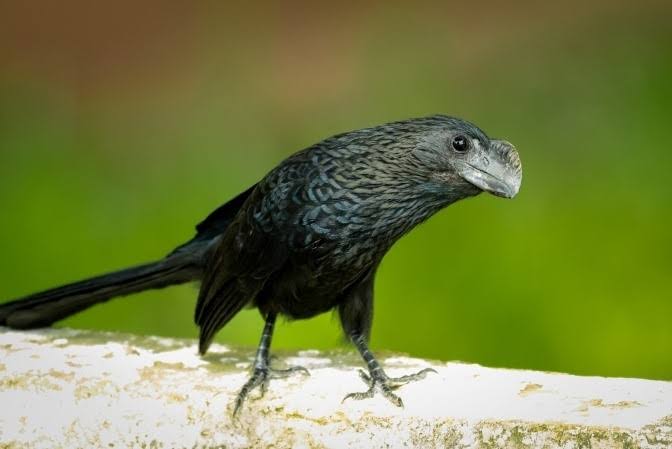
The smooth-billed Ani is a medium-sized cuckoo with completely black plumage. Adults have a large, curved bill with a noticeable ridge along the top. They also have short, rounded wings and a long tail.
Smooth-billed Anis usually move in groups and can often be seen feeding, resting, and traveling together.
They are commonly found in open and semi-open habitats rather than deep forests.
What Does a Smooth-billed Ani Look Like?
The Smooth-billed Ani has several features that make identification easier.
- Black feathers over the entire body
- Large, curved black bill
- Long tail
- Short, rounded wings
- Dark eyes
- Strong, distinctive body shape
Young birds look similar to adults but do not have the same prominent ridge on the upper bill.
The large bill is one of the best features to use when identifying this species.
Where Does the Smooth-billed Ani Live?
Smooth-billed Anis are widely distributed across tropical regions of Central and South America and the Caribbean.
They are also found in southern Florida, although the Florida population is much smaller.
They can live in many different environments, including:
- Pastures
- Grasslands
- Shrublands
- Open woodland
- Orchards
- Gardens
- Agricultural areas
- Forest edges
- Wetlands
- Areas near rivers and ponds
They often prefer places with low vegetation where they can easily search for insects and other food.
Smooth-billed Ani Habitat
The species does well in habitats with shrubs, vines, grasses, reeds, and small trees.
Water can also be important. Smooth-billed Anis are often found around ponds, rivers, marshes, and other wet areas.
They can adapt to human-altered environments, which is one reason they are found in places such as farms, gardens, plantations, and suburban areas.
What Does a Smooth-billed Ani Eat?
Smooth-billed Anis are omnivores with a varied diet.
They commonly eat insects and other small animals, along with fruits and berries.
Their diet can include:
- Grasshoppers
- Beetles
- Caterpillars
- Cicadas
- Flies
- Dragonflies
- Ants
- Small lizards
- Tree frogs
- Snails
- Fruits
- Berries
They often search for food on or close to the ground and move through vegetation looking for insects.
How Does the Smooth-billed Ani Find Food?
The smooth-billed Ani is an active forager.
It may walk or hop through grass and shrubs while looking for insects. Its large bill is useful for moving through vegetation and reaching hidden prey.
Smooth-billed Anis may also follow cattle and other large animals. As livestock move through grass, they disturb insects, making them easier for the birds to find.
They may also gather around army ant swarms because the ants disturb insects and other small animals.
Are Smooth-billed Anis Social Birds?
Yes. Smooth-billed Anis are highly social birds.
They often live in groups that include several breeding pairs and their offspring. Group members may feed, travel, rest, and protect their territory together.
While some birds search for food, others may stay in higher positions and watch for predators.
This group behavior helps the birds stay alert while feeding.
How Do Smooth-Billed Anis Nest?
Smooth-billed Anis have an unusual nesting system called communal nesting.
Instead of each female building a separate nest, several females in the same group may lay their eggs in one shared nest.
The nest is usually built in a tree or shrub and is made from twigs and leaves.
Multiple birds can help build the nest and care for the eggs and young.
How Many Eggs Does a Smooth-billed Ani Lay?
A communal nest can contain many eggs because several females may lay in the same nest.
The eggs are pale blue with a chalky appearance.
A single nest can contain up to several dozen eggs. Because females continue adding eggs, some older eggs may become covered by newer eggs and nesting material.
This makes communal nesting one of the most unusual features of the Smooth-billed Ani.
How Do Smooth-billed Anis Raise Their Chicks?
Raising young is a group effort.
Several adults can help incubate the eggs and feed the chicks. Young birds may remain with the family group for an extended period.
Older juveniles can also help care for younger chicks.
This cooperative behavior allows multiple members of the group to contribute to raising the next generation.
Where Do Smooth-billed Anis Sleep?
Smooth-billed Anis often roost together as a group.
They may gather in dense vegetation, trees, reeds, or other sheltered areas, particularly near water.
Sleeping together may provide protection and allow the group to remain together during the night.
How Do Smooth-billed Anis Communicate?
These birds use calls to communicate with members of their group.
Their vocalizations can help birds maintain contact while moving through vegetation and can also alert other group members when danger is nearby.
They are often easier to notice when several birds are calling and moving together.
Smooth-billed Ani vs Groove-billed Ani
The Smooth-billed Ani is closely related to the Groove-billed Ani, and the two can look similar.
The easiest way to tell them apart is by looking at the bill.
The Smooth-billed Ani has a relatively smooth bill with a prominent ridge, while the Groove-billed Ani has grooves running along its bill.
Habitat can also provide a clue. Smooth-billed Anis are often associated with wetter environments, while Groove-billed Anis are commonly found in drier open habitats.
Where Are Smooth-billed Anis Found?
Smooth-billed Anis are native to tropical regions of the Americas, including parts of South America, Central America, the Caribbean, and southern Florida.
They are also found in the Galápagos Islands, where they were introduced in the 1960s.
Today, they are established across much of the archipelago and are considered an invasive species.
They have been recorded on many Galápagos islands and commonly live in agricultural areas, dry habitats, coastal areas, and other areas with suitable vegetation.
Can You Find Smooth-billed Anis in Florida?
Yes, but they are not as common in Florida as they are across much of their wider range.
Their Florida population has declined over the years, making them a less common bird to find there.
They are most likely to be found in suitable areas with open vegetation and access to food and water.
Are Smooth-billed Anis Endangered?
The Smooth-billed Ani is not considered endangered across its overall range.
It remains common across much of South America, Central America, and the Caribbean.
However, local populations can face problems caused by habitat changes, pesticide use, and extreme weather.
The situation in Florida shows how a species can remain common globally while becoming less common in a particular region.
Interesting Smooth-billed Ani Facts
Here are some quick facts about this unusual bird:
- The smooth-billed Ani belongs to the cuckoo family.
- Its scientific name is Crotophaga ani.
- It has completely black plumage.
- Its large curved bill is one of its most recognizable features.
- It often lives in groups.
- Several females can lay eggs in one communal nest.
- Group members help raise the young.
- It eats insects, small animals, fruits, and berries.
- It may follow cattle while searching for insects.
- It can live in farms, gardens, pastures, wetlands, and forest edges.
- Young birds may remain with the group and help care for younger chicks.
Why Is the Smooth-billed Ani Interesting?
The smooth-billed Ani stands out because of its combination of appearance and behavior.
Its black body and oversized bill make it easy to identify, but its social lifestyle is what makes it especially interesting. Several adults can live together, share a nest, defend their territory, and help raise young.
Its flexible diet and ability to live in different habitats also allow it to thrive across a large part of the tropical Americas.

FAQs About Smooth-billed Anis
Are Smooth-billed Anis native to the Galápagos Islands?
No. Smooth-billed Anis are an introduced species in the Galápagos rather than a native or endemic bird.
When were Smooth-billed Anis introduced to the Galápagos?
They were introduced to the Galápagos in the 1960s and have since become established on several islands.
Which Galápagos Islands have Smooth-billed Anis?
They have been recorded on several islands across the archipelago, including Santa Cruz, Isabela, San Cristóbal, Santiago, Floreana, and others.
Why were Smooth-billed Anis introduced to the Galápagos?
They were reportedly introduced in an attempt to control ticks affecting livestock.
Do Smooth-billed Anis migrate?
Smooth-billed Anis generally do not undertake long-distance seasonal migrations. They usually remain within suitable habitats and may move locally when food or environmental conditions change.
How can you identify a Smooth-billed Ani in the wild?
Look for an entirely black bird with a long tail and a large, curved bill. The distinctive shape of its bill is one of the easiest ways to identify it.
Do Smooth-billed Anis live alone?
No. They are highly social birds and commonly live, feed, rest, and raise young in groups.
What predators eat Smooth-billed Anis?
Their eggs and young can be vulnerable to predators, although the specific predators can vary depending on the location and habitat.
Do Smooth-billed Anis have natural predators in the Galápagos?
They can face threats from native and introduced predators, particularly during nesting. The exact impact varies between islands and habitats.
Why are Smooth-billed Anis considered a concern in the Galápagos?
Because they are an introduced species, they can interact with native wildlife and ecosystems. Their presence has raised concerns about nest predation, competition, invasive plant seed dispersal, and their role in spreading parasites.
Conclusion
The smooth-billed Ani is a unique member of the cuckoo family with a completely black body, long tail, large curved bill, and highly social lifestyle.
It lives in a variety of open and semi-open habitats and feeds on insects, small animals, fruits, and berries. Its communal nesting behavior is particularly unusual, with several females sometimes laying eggs in the same nest and multiple adults helping raise the chicks.
For birdwatchers, the Smooth-billed Ani is a fascinating species to look for. If you spot a group of black birds moving through shrubs, fields, or wetland vegetation, take a closer look. Their unusual bill, long tail, and social behavior may reveal that you are looking at a smooth-billed Ani.