The Galapagos Islands are home to some of the most unique wildlife on Earth. Giant tortoises, marine iguanas, blue-footed boobies, and Darwin’s finches attract visitors from around the world. Among these famous animals is a bird that many people never expect to see: the Galapagos Short eared Owl.
Unlike many owls that stay hidden during the day, the Galapagos Short eared Owl can sometimes be seen hunting in daylight. It is one of the top predators in the islands and plays an important role in keeping nature balanced. Although it is not as well-known as some of the other animals found in the Galapagos, spotting one in the wild is an exciting experience for birdwatchers, photographers, and nature lovers.
In this guide, you’ll learn everything you need to know about the Galapagos Short eared Owl, including where it lives, what it eats, how it hunts, how it raises its young, and why it is such an important part of the Galapagos ecosystem.
What Is the Galapagos Short eared Owl?
The Galapagos Short eared Owl is a subspecies of the Short eared Owl that has adapted to life on the Galapagos Islands. It belongs to the owl family and is known for its excellent eyesight, sharp hearing, and silent flight.
Its scientific name is Asio flammeus galapagoensis.
Like other animals in the Galapagos, this owl has evolved over thousands of years to survive in the unique island environment. Because the islands have fewer natural predators than many mainland habitats, the owl has developed behaviors that are slightly different from its relatives found elsewhere in the world.
Although many owls are active only at night, the Galapagos Short eared Owl is often active during dawn, dusk, and sometimes even during daylight hours.
Where Does the Galapagos Short eared Owl Live?
The Galapagos Short eared Owl can be found on several islands throughout the Galapagos archipelago.
It prefers open landscapes where it has a clear view of its surroundings. These habitats include:
- Lava fields
- Dry forests
- Grasslands
- Coastal plains
- Rocky hillsides
- Shrub-covered areas
Unlike forest owls that spend much of their time in tall trees, the Galapagos Short eared Owl often hunts over open ground where it can easily spot prey.
Different islands may have different populations depending on food availability and habitat conditions.
Which Galapagos Islands Have Short eared Owls?
Visitors have reported seeing Galapagos Short eared Owls on several islands, including:
- Isabela Island
- Santa Cruz Island
- Santiago Island
- Fernandina Island
- Genovesa Island
The exact locations where owls are found may change depending on food supplies and seasonal conditions.
Because they blend into the rocky landscape, they can sometimes be difficult to spot unless you know where to look.
What Does the Galapagos Short eared Owl Look Like?
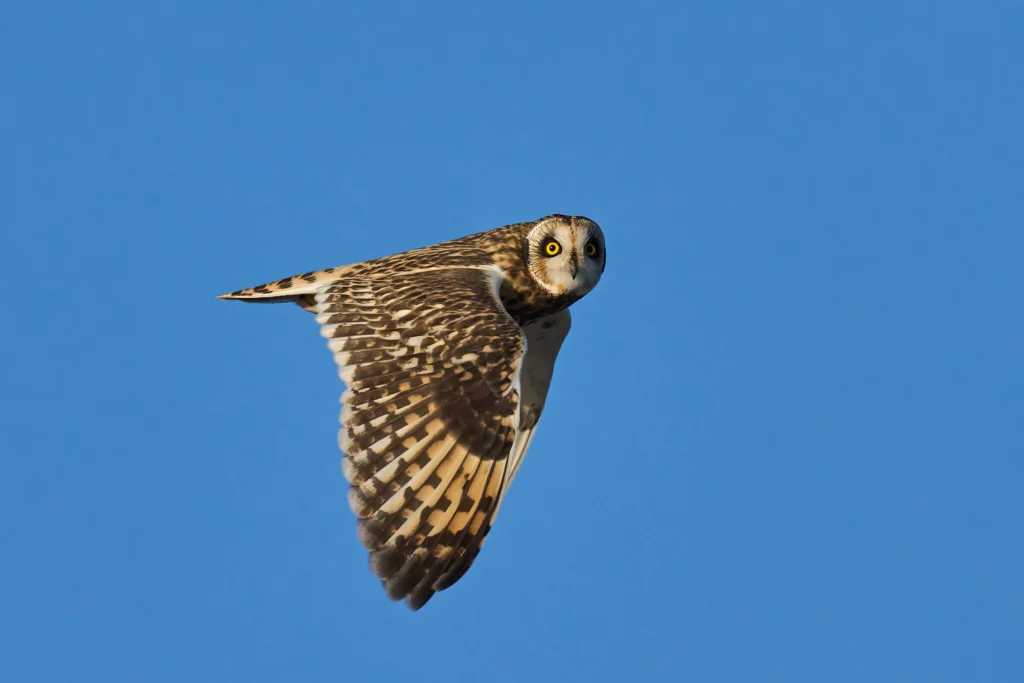
The Galapagos Short eared Owl has excellent camouflage that helps it blend into the dry volcanic landscape.
Some of its physical features include:
- Brown and tan feathers
- Dark streaks across the body
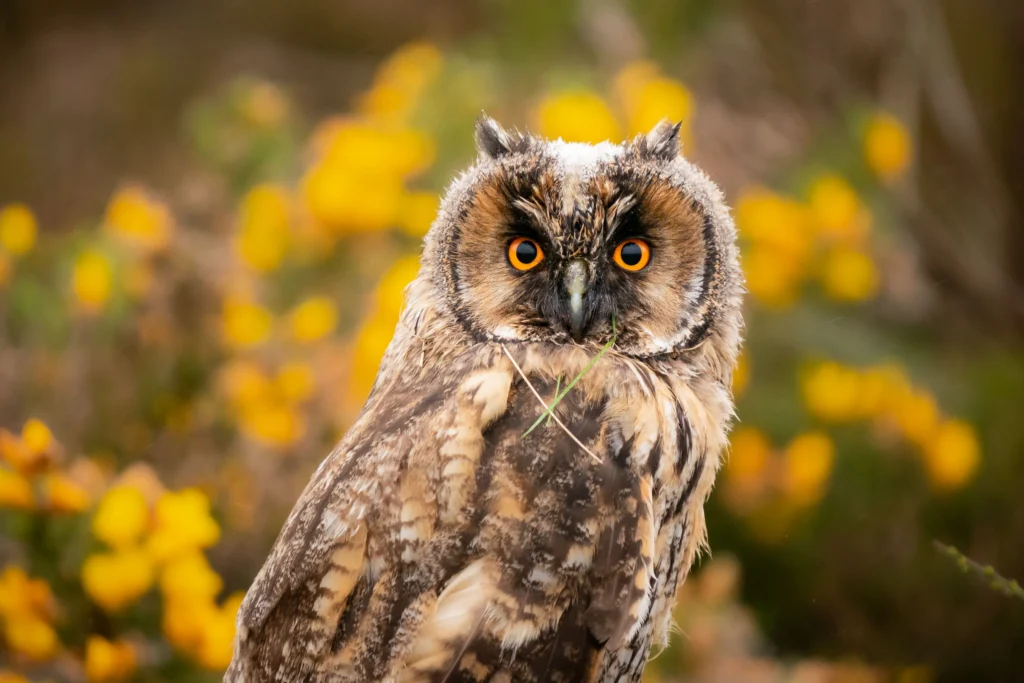
- Pale face with large yellow eyes
- Small feather tufts that are usually difficult to see
- Rounded wings
- Long wings compared to its body size
- Sharp black beak
- Strong talons for catching prey
Its feather pattern helps it disappear among rocks, dry grass, and volcanic soil.
This natural camouflage protects it while resting during the day.
Why Is It Called a Short eared Owl?
Despite its name, the owl does not actually have short ears.
The “ears” are small feather tufts located on top of its head.
Unlike Great Horned Owls, these feather tufts are usually difficult to notice because they remain flat against the head most of the time.
The owl’s real ears are hidden beneath its feathers.
How Big Is the Galapagos Short eared Owl?
The Galapagos Short eared Owl is considered a medium-sized owl.
Adults generally measure around:
- Length: 13 to 17 inches
- Wingspan: About 33 to 40 inches
- Weight: Around 7 to 17 ounces
Females are often slightly larger than males, which is common among many owl species.
Although it is not the largest owl in the world, its wide wings allow it to fly smoothly while searching for prey.
How Does the Galapagos Short eared Owl Hunt?
The Galapagos Short eared Owl is an incredibly skilled hunter.
Instead of sitting on a tree branch waiting for prey, it often flies low over the ground while searching for movement.
Its silent flight gives prey very little warning.
The owl relies on:
- Excellent eyesight
- Highly sensitive hearing
- Powerful talons
- Quick reflexes
Once it spots prey, it quickly swoops down and captures it with its sharp claws.
Its silent feathers help reduce noise during flight, making it one of nature’s most efficient hunters.
Is the Galapagos Short eared Owl Active During the Day?
Unlike many owl species, the Galapagos Short eared Owl is not strictly nocturnal.
It is most active:
- Early morning
- Late afternoon
- Around sunset
- During cloudy weather
- Occasionally in broad daylight
This behavior surprises many visitors because most people expect owls to appear only after dark.
The availability of prey often influences when the owl hunts.
What Does the Galapagos Short eared Owl Eat?
The Galapagos Short eared Owl is a carnivore.
Its diet changes depending on what is available on each island.
Common prey includes:
- Lava lizards
- Small birds
- Young seabirds
- Rodents
- Large insects
- Beetles
- Grasshoppers
- Small reptiles
It is an opportunistic hunter, meaning it takes advantage of whatever prey is easiest to catch.
This flexibility helps it survive in the changing island environment.
Does It Hunt Other Galapagos Birds?
Yes.
One of the more interesting behaviors of the Galapagos Short eared Owl is that it sometimes hunts young seabirds.
On islands where seabird colonies are common, the owl may prey on:
- Storm petrels
- Young shearwaters
- Small nesting birds
This may seem surprising, but predators play an important role in maintaining healthy wildlife populations.
By hunting weaker or more vulnerable animals, owls help maintain ecological balance.
Why Is the Galapagos Short eared Owl Important?
Every species in the Galapagos has a role in the ecosystem.
The Galapagos Short eared Owl helps control populations of rodents, insects, reptiles, and small birds.
Without natural predators, prey populations could increase beyond what the environment can support.
Healthy predator populations contribute to a balanced ecosystem where different species can coexist.
Behavior of the Galapagos Short eared Owl
The Galapagos Short eared Owl is generally a quiet and solitary bird. Unlike some birds that gather in large flocks, these owls usually spend much of their time alone or with a mate during the breeding season.
They are highly alert and constantly watch their surroundings. Their excellent vision and hearing help them detect even the smallest movement on the ground.
When they are not hunting, they often rest on the ground, rocky outcrops, low shrubs, or hidden areas where their feather colors help them blend into the landscape. Their camouflage is so effective that people can walk nearby without noticing an owl sitting only a short distance away.
Although they prefer to avoid people, they may remain still instead of flying away if they feel they are not in immediate danger.
How Does the Galapagos Short eared Owl Communicate?
Like many owl species, the Galapagos Short eared Owl communicates through a variety of sounds and body movements.
Its calls are most often heard during the breeding season or when defending its territory. These sounds can include low hoots, barks, whistles, and other vocal calls.
The owl also communicates by:
- Changing its posture
- Fluffing its feathers
- Spreading its wings
- Flying in special display patterns
- Using eye contact with other owls
Because these birds are usually active around sunrise and sunset, visitors are more likely to hear them during these quieter times of the day.
Breeding Season
The breeding season of the Galapagos Short eared Owl depends on food availability and environmental conditions.
Unlike birds that breed at exactly the same time every year, these owls may adjust their nesting season based on rainfall and the amount of prey available.
When food is plentiful, the chances of successfully raising young are much higher.
During courtship, the male performs flight displays and calls to attract a female. These displays may include slow flights, gentle dives, and repeated vocalizations.
Once a pair forms, they usually remain together throughout the nesting period.
Where Do They Build Their Nests?
Unlike many owls that nest in tree cavities, the Galapagos Short eared Owl usually nests on the ground.
It chooses locations that provide natural protection, such as:
- Thick grass
- Low shrubs
- Rocky areas
- Lava fields
- Small depressions in the ground
The nest itself is simple. The female may scrape a shallow hollow in the ground and line it with grasses, feathers, or other soft materials.
Ground nests make camouflage especially important because eggs and chicks are more exposed than those in tree nests.
Fortunately, the owl’s feather colors blend well with the volcanic landscape.
How Many Eggs Does the Female Lay?
The number of eggs varies depending on environmental conditions and food availability.
A female usually lays between 3 and 7 eggs, although some nests may contain fewer or more.
The eggs are white and nearly round, making them easy to recognize compared to the patterned eggs of many other bird species.
The female lays one egg every day or two until the clutch is complete.
Incubation Period
After the eggs are laid, the female begins incubating them.
Incubation usually lasts about three to four weeks.
During this time, the female stays close to the nest to keep the eggs warm and protected.
The male plays an important role by hunting and bringing food to the female while she remains with the eggs.
This teamwork increases the chances that the chicks will hatch successfully.
What Are Baby Galapagos Short eared Owls Like?
Newly hatched chicks are covered in soft white down instead of adult feathers.
At first, they are completely dependent on their parents for food and protection.
The parents feed the chicks small pieces of prey that are easy to swallow.
As the chicks grow, they begin developing stronger feathers and become more active around the nest.
Their large eyes and fluffy appearance make them look very different from the fully grown adults.
How Long Do Young Owls Stay With Their Parents?
Young owls remain near the nest for several weeks after hatching.
During this time, they learn important survival skills such as:
- Recognizing prey
- Strengthening their wings
- Practicing short flights
- Watching their parents hunt
- Learning how to respond to danger
Even after leaving the nest, young owls may continue depending on their parents for food until they become skilled hunters.
Eventually, they leave to establish territories of their own.
How Long Does the Galapagos Short eared Owl Live?
The lifespan of a Galapagos Short eared Owl depends on many factors, including food availability, habitat quality, disease, and predators.
In the wild, many individuals live for several years, while some survive much longer under favorable conditions.
Young owls face the greatest risks during their first year of life because they are still learning how to hunt and avoid danger.
Adults that successfully establish territories often have a better chance of long-term survival.
Does the Galapagos Short eared Owl Have Natural Predators?
Adult Galapagos Short eared Owls have relatively few natural predators because they are among the top hunters on the islands.
However, eggs and young chicks are much more vulnerable.
Possible threats include:
- Larger birds
- Introduced mammals in some areas
- Nest disturbance
- Harsh weather
- Lack of food
Protecting nesting areas helps improve the survival of young owls.
Amazing Adaptations
The Galapagos Short eared Owl has several remarkable adaptations that help it survive.
Silent Flight
Like most owls, its feathers are specially designed to reduce noise during flight.
This allows the owl to approach prey without being heard.
Exceptional Hearing
Its ears can detect very small sounds, even when prey is hidden beneath vegetation or rocks.
This gives the owl an advantage when hunting in low light.
Excellent Vision
Large eyes help the owl see well during dawn, dusk, and nighttime.
Although it sometimes hunts during the day, its vision is especially useful in dim conditions.
Powerful Talons
The owl’s sharp claws allow it to catch and hold struggling prey.
Its strong grip makes it an effective predator despite its medium size.
Natural Camouflage
The brown, tan, and black patterns on its feathers blend perfectly with volcanic rocks, dry grasses, and shrubs.
This camouflage protects both adults and young birds from being noticed.
Why Birdwatchers Love Seeing This Owl
For many visitors, spotting a Galapagos Short eared Owl is one of the highlights of their trip.
Unlike more colorful birds that are easy to find, these owls require patience and careful observation.
Finding one resting quietly among lava rocks or watching it glide silently across an open field is a memorable experience.
Because sightings are less common than many other Galapagos birds, birdwatchers often consider it one of the islands’ special wildlife encounters.
Threats to the Galapagos Short eared Owl
Although the Galapagos Short eared Owl is a skilled predator, it still faces several challenges. The Galapagos Islands are protected, but both natural and human-related factors can affect the owl’s survival.
Understanding these threats helps explain why conservation is so important.
Habitat Changes
The Galapagos landscape changes naturally over time due to volcanic activity, weather patterns, and seasonal rainfall. While the owl has adapted to these natural changes, human activities can also affect its habitat.
Trails, buildings, roads, and other developments may reduce the amount of suitable nesting and hunting areas if they are not carefully managed.
Fortunately, much of the Galapagos National Park is protected, helping preserve the owl’s natural environment.
Introduced Species
One of the biggest threats to wildlife in the Galapagos is the introduction of non-native animals.
Species such as rats, cats, and dogs can disturb nests or prey on eggs and young chicks. Introduced rodents may also compete with native wildlife for food or change the balance of the ecosystem.
Conservation programs across the islands work to control invasive species and reduce their impact on native animals.
Climate Change
Climate change may also affect the Galapagos Short eared Owl.
Changes in rainfall patterns and temperatures can influence the number of insects, reptiles, rodents, and birds that the owl depends on for food.
Extreme weather events may also affect breeding success if nests are damaged or food becomes harder to find.
Scientists continue to study how climate change may influence wildlife across the Galapagos Islands.
Human Disturbance
Although many visitors come to admire the wildlife, getting too close to nesting birds can cause unnecessary stress.
If an owl feels threatened, it may leave its nest temporarily, leaving eggs or chicks exposed to heat, cold, or predators.
This is why visitors are encouraged to stay on marked trails and follow the instructions of certified naturalist guides.
Respecting wildlife helps protect future generations of Galapagos animals.
Conservation Efforts
The Galapagos Islands are one of the world’s most carefully protected natural areas.
Many organizations work together to protect native wildlife, including the Galapagos Short eared Owl.
Conservation efforts include:
- Protecting natural habitats
- Controlling invasive species
- Monitoring wildlife populations
- Supporting scientific research
- Educating visitors about responsible tourism
- Enforcing conservation laws
These efforts help maintain the unique biodiversity that makes the Galapagos Islands famous around the world.
Why the Owl Is Important to the Ecosystem
Every animal has a role in nature, and the Galapagos Short eared Owl is no exception.
As a predator, it helps control populations of:
- Rodents
- Lava lizards
- Large insects
- Small birds
Without predators like the owl, these animal populations could grow too quickly, putting pressure on the limited food and resources available on the islands.
A balanced ecosystem depends on both predators and prey.
Relationship With Other Galapagos Wildlife
The Galapagos Short eared Owl shares its habitat with many famous species.
While exploring the islands, you may see the owl living alongside:
- Galapagos giant tortoises
- Marine iguanas
- Land iguanas
- Blue-footed boobies
- Nazca boobies
- Darwin’s finches
- Galapagos hawks
- Lava lizards
- Sea lions
Each species has its own role, creating one of the world’s most fascinating ecosystems.
Unlike herbivores such as tortoises and iguanas, the owl is an active hunter that helps keep prey populations under control.
Where Can You See the Galapagos Short eared Owl?
Seeing a Galapagos Short eared Owl requires patience, but it is possible on several islands.
Some of the best places include:
Isabela Island
Isabela is the largest island in the Galapagos and offers excellent wildlife viewing opportunities.
Its lava fields, open grasslands, and coastal habitats provide ideal hunting areas for the owl.
Santa Cruz Island
Santa Cruz is one of the most visited islands and has several areas where birdwatchers occasionally spot Short eared Owls.
Early morning walks offer the best chance of seeing one.
Santiago Island
Santiago has extensive volcanic landscapes that blend perfectly with the owl’s feather colors.
Visitors often search open lava fields during guided tours.
Fernandina Island
Fernandina remains one of the most untouched islands in the archipelago.
Its healthy ecosystem supports many native species, including the Galapagos Short eared Owl.
Genovesa Island
Known as Bird Island, Genovesa is famous for its seabird colonies.
Because seabirds are abundant here, it can also be a rewarding place to observe the owl hunting near nesting areas.
Best Time to Spot a Galapagos Short eared Owl
Although sightings are never guaranteed, your chances improve if you visit during the owl’s most active periods.
The best times include:
- Shortly after sunrise
- Late afternoon
- Around sunset
- Cloudy days with cooler temperatures
These periods are when the owl is most likely to be hunting.
Bringing binoculars can greatly improve your chances of spotting one from a distance.
Photography Tips
Photographing a Galapagos Short eared Owl can be challenging because of its excellent camouflage.
Here are a few helpful tips:
- Carry a telephoto lens.
- Keep a respectful distance.
- Never disturb a nesting owl.
- Use natural light whenever possible.
- Be patient and observe quietly.
- Listen to your guide, who may know recent owl locations.
The best wildlife photographs are taken without interfering with the animal’s natural behavior.
Interesting Facts About the Galapagos Short eared Owl
Here are some fascinating facts about this remarkable bird:
- It is one of the few owl species regularly seen hunting during daylight.
- Its feathers allow it to fly almost silently.
- It can rotate its head much farther than humans.
- Its hearing is sensitive enough to detect small animals moving through vegetation.
- It nests on the ground instead of in trees.
- Its feather colors provide outstanding camouflage against volcanic rocks.
- It is considered one of the top predators on several Galapagos Islands.
- Young owls depend on their parents for several weeks after hatching.
- Every owl helps maintain the natural balance of the island ecosystem.
- Spotting one is considered a special experience by many birdwatchers.
Why Protecting This Owl Matters
The Galapagos Islands are often called a living laboratory of evolution because so many species are found nowhere else on Earth.
Protecting the Galapagos Short eared Owl also helps protect countless other native plants and animals that share its habitat.
Conservation is not only about saving one species. It is about preserving an entire ecosystem that has evolved over millions of years.
Responsible tourism, scientific research, and habitat protection all play an important role in ensuring that future generations can continue to enjoy the incredible wildlife of the Galapagos.
FAQs About Galapagos Short eared Owl
Is the Galapagos Short eared Owl found anywhere outside the Galapagos Islands?
The Galapagos Short eared Owl is a subspecies that is native to the Galapagos Islands. While Short eared Owls are found in many parts of the world, this particular subspecies is unique to the archipelago.
Does the Galapagos Short eared Owl migrate?
No. Unlike some mainland Short eared Owl populations that migrate seasonally, the Galapagos Short eared Owl is considered a resident bird and remains on the islands year-round.
How can you tell a male from a female Galapagos Short eared Owl?
Males and females look very similar, making them difficult to distinguish in the wild. Females are generally slightly larger than males.
Is the Galapagos Short eared Owl endangered?
The Galapagos Short eared Owl is not currently classified as endangered, but protecting its habitat and controlling invasive species remain important for its long-term survival.
Can visitors hear the Galapagos Short eared Owl at night?
Yes. Although they are often quiet, visitors may occasionally hear their calls during the evening, early morning, or breeding season.
What role does the Galapagos Short eared Owl play in scientific research?
Scientists study the owl to better understand predator-prey relationships, island ecosystems, and how species adapt to isolated environments like the Galapagos.
Can the Galapagos Short eared Owl live in captivity?
While some owl species can be cared for in wildlife rehabilitation centers, the Galapagos Short eared Owl is a protected wild bird and is not kept as a pet or for general public display.
What should you do if you spot a Galapagos Short eared Owl while hiking?
Observe it quietly from a safe distance, avoid making loud noises, never attempt to feed it, and follow all park regulations to avoid disturbing the bird.
How does the Galapagos Short eared Owl survive during dry seasons?
It adapts by hunting whatever prey is most available, including insects, reptiles, rodents, and small birds, allowing it to survive even when food sources change.
Why is the Galapagos Short eared Owl considered a special sighting?
Unlike many of the islands’ more common birds, the Galapagos Short eared Owl is naturally well-camouflaged and less frequently seen, making every sighting a memorable experience for visitors and birdwatchers.
Conclusion
The Galapagos Short eared Owl may not be as famous as the giant tortoise or the blue-footed booby, but it is one of the islands’ most fascinating predators. With its silent flight, sharp eyesight, remarkable hearing, and excellent camouflage, it is perfectly adapted to life in the volcanic landscapes of the Galapagos.
Whether it is hunting over open lava fields, raising chicks in a hidden ground nest, or quietly watching its surroundings from a rocky perch, this owl is a reminder of how unique the wildlife of the Galapagos truly is.
If you are planning a trip to the Galapagos Islands, keep your binoculars ready and your eyes on the open landscapes. Spotting a Galapagos Short eared Owl in its natural habitat is a rare and unforgettable experience that highlights the beauty and diversity of one of the world’s most extraordinary ecosystems.