The American flamingo is one of the most recognizable birds in the world. With its long legs, curved bill, bright pink feathers, and distinctive habit of standing in shallow water, it is difficult to mistake for another bird.
But there is much more to the American flamingo than its appearance. This remarkable bird has adapted to some of the most challenging wetland environments in the Americas. It can live around salty lagoons, coastal mudflats, mangroves, and shallow lakes where relatively few other birds can thrive.
Whether you are interested in identifying one in the wild, learning about its diet, understanding where it lives, or simply finding out why flamingos are pink, this guide covers the essentials.
Key Takeaways
- The American flamingo is a highly adaptable wading bird known for its pink plumage, long legs, and curved bill.
- Its pink and reddish coloring comes largely from carotenoid pigments in its diet.
- American flamingos live mainly in Caribbean, Central American, and northern South American wetlands.
- Protecting shallow coastal wetlands, lagoons, and other feeding and breeding habitats is essential for healthy flamingo populations.
What Is an American Flamingo?
The American flamingo (Phoenicopterus ruber) is a large wading bird belonging to the flamingo family, Phoenicopteridae.
It is also sometimes called the Caribbean flamingo, particularly because large populations are associated with the Caribbean region.
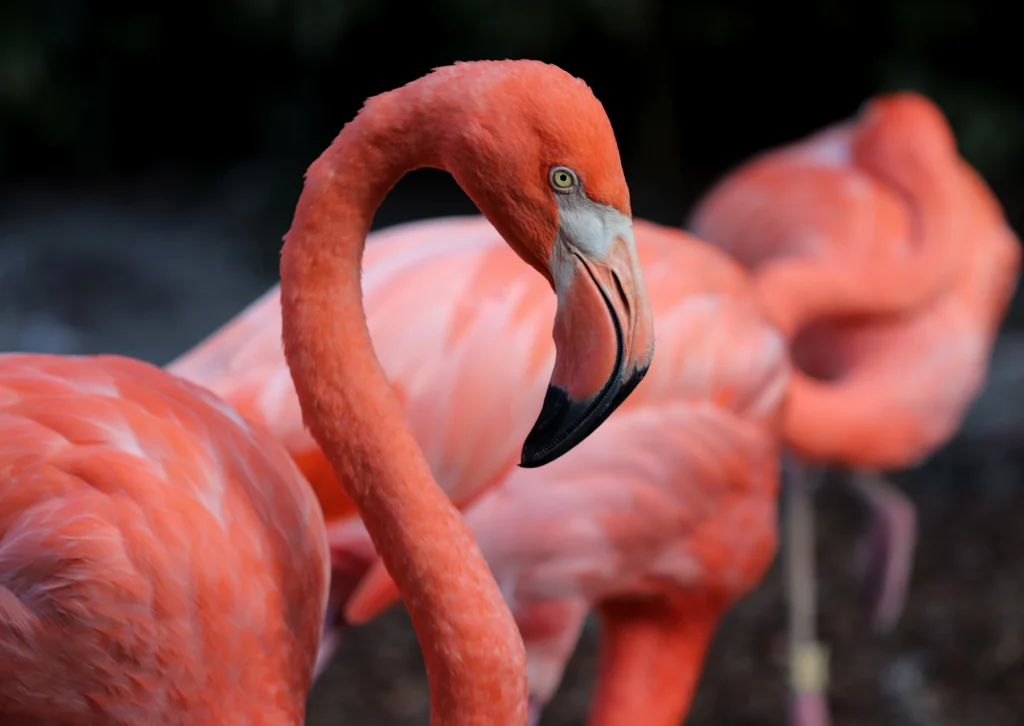
Adult American flamingos are known for their vivid pink to reddish plumage, long pink legs, and large, strongly curved bills. Their wings can show much darker feathers, creating a striking contrast when the birds take flight.
Although they look delicate from a distance, flamingos are well adapted to environments that can be difficult for many other birds to use.
They frequently live around shallow water where they can feed on small aquatic organisms and plant material.
What Does an American Flamingo Look Like?
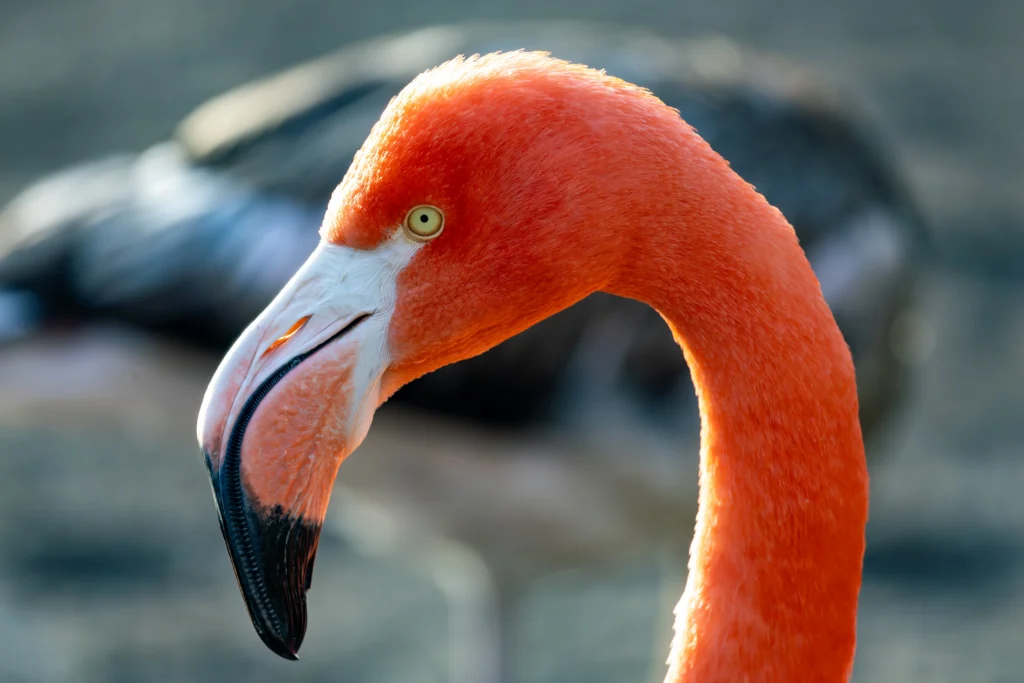
The easiest way to identify an American flamingo is to look at its overall shape.
Adults have:
- Long, slender legs
- A long neck
- A large, downward-curved bill
- Pink, coral, and reddish feathers
- Darker wing feathers
- A relatively large body
- Webbed feet
Their bills are particularly unusual. The shape is not simply designed for picking food from the water. Instead, the flamingo uses its bill as a specialized filtering tool.
The color of an individual can vary. Some birds appear relatively pale pink, while others have much deeper coral or reddish coloring.
Young flamingos look very different from adults. Chicks are generally covered in soft grayish or whitish down, and their plumage gradually changes as they grow.
This means that seeing a pale or gray flamingo does not necessarily mean you are looking at a different species.
Why Are American Flamingos Pink?
One of the most common questions about flamingos is where their color comes from.
The answer is their diet.
American flamingos consume food containing natural pigments called carotenoids. These pigments are found in various algae and small aquatic organisms.
As the bird processes these pigments, they contribute to the pink, orange, and reddish colors in its feathers, skin, and other tissues.
This is why flamingos raised on diets lacking sufficient carotenoids can become much paler.
In other words, a flamingo’s bright coloring is partly a reflection of what it eats.
The exact shade can vary between individuals and populations depending on diet, age, health, and other factors.
Where Do American Flamingos Live?
American flamingos are primarily associated with the Caribbean, parts of Central America, and northern South America.
They use a variety of wetland habitats, including:
- Coastal lagoons
- Shallow saltwater areas
- Mudflats
- Mangrove wetlands
- Estuaries
- Saline and alkaline lakes
- Tidal flats
These environments provide the shallow water and food resources flamingos need.
One of the fascinating things about flamingo habitat is that it can appear relatively barren compared with forests or freshwater wetlands.
A salty lagoon surrounded by mud and exposed ground might not seem like an ideal place for wildlife. Yet these conditions can support enormous numbers of specialized organisms, giving flamingos an important food source.
Do American Flamingos Live in Florida?
American flamingos have a long association with Florida and the wider Caribbean region.
Historically, flamingos were treated inconsistently in discussions about Florida’s native bird populations, partly because their movements make determining where birds originate more complicated.
Today, American flamingos are increasingly recognized as naturally occurring birds in Florida, particularly in suitable coastal wetland habitats.
Seeing a flamingo in Florida is still an exciting experience because these birds are not something most people encounter every day.
When one appears, observers may initially wonder whether it escaped from captivity. In some cases that can be relevant, but naturally occurring flamingos are also documented in the state.
What Do American Flamingos Eat?
American flamingos are filter feeders.
Rather than hunting large prey, they use their specialized bills to collect tiny organisms and particles from shallow water.
Their diet can include:
- Algae
- Small crustaceans
- Tiny aquatic organisms
- Mollusks
- Other microscopic or small food items
- Organic particles
The exact diet can vary depending on the habitat and what food is available.
Their bill is specially adapted to this feeding strategy. Flamingos can place their bills into shallow water and use filtering structures inside the bill to separate food from water and sediment.
Their feeding behavior can look almost backward compared with the way many birds feed. They often bend their long necks downward and position the bill in the water while moving it through the sediment or water column.
How Do Flamingos Feed?
Watching a flamingo feed is one of the best ways to appreciate how specialized the bird is.
A flamingo may stand in shallow water, lower its head, and position its bill upside down or nearly upside down.
It then moves the bill through the water while filtering out small food particles.
Their tongues and bill structures help move water and food through this filtering system.
Flamingos may also stir the bottom of shallow water with their feet.
This movement can disturb sediment and help bring potential food items into the water where they can be filtered.
A group of flamingos feeding together can create an impressive scene, with dozens or even hundreds of birds moving through the same shallow wetland.
Why Do Flamingos Stand on One Leg?
The classic one-legged flamingo pose is more than just a quirky behavior.
Flamingos frequently rest while standing on one leg, and researchers have studied how they are able to maintain this position so efficiently.
Their body structure allows them to support themselves with relatively little muscular effort when standing in certain positions.
Standing on one leg may also help reduce heat loss through the legs, although the exact reasons for the behavior are complex and may vary depending on conditions.
Importantly, flamingos do not need to balance constantly through active muscular effort in the same way a human might when standing on one foot.
Their anatomy helps make the posture remarkably stable.
And, of course, flamingos are perfectly capable of standing on two legs when they need to.
Can American Flamingos Fly?
Yes. Despite their long legs and somewhat awkward appearance when walking, American flamingos are strong fliers.
When they take off, they often need a running start, especially from water or soft ground.
Once airborne, their long wings allow them to travel considerable distances.
Their necks and legs extend outward during flight, giving them a distinctive silhouette.
Large groups can fly together in formations, sometimes creating spectacular displays over wetlands.
Their ability to fly is important because flamingos may move between feeding areas, breeding sites, and other suitable wetlands depending on environmental conditions.
Are American Flamingos Social Birds?
Very much so.
American flamingos are highly social and commonly live in groups.
These groups can range from relatively small gatherings to enormous colonies containing thousands of birds.
Living in groups provides several advantages. More eyes can help detect potential predators, while large concentrations of birds can make it easier to locate productive feeding areas.
Their social behavior is especially noticeable during breeding.
A large flamingo colony can become surprisingly noisy, with birds calling to one another and performing coordinated displays.
How Do American Flamingos Communicate?
Flamingos are much more vocal than their appearance might suggest.
They use a range of calls to communicate with one another.
Adults and young birds need to recognize each other, particularly within large colonies where many individuals may be gathered close together.
Vocal communication can help parents locate their chicks and can also play a role in maintaining social relationships.
A large colony of flamingos is therefore not a silent gathering of pink birds. It can be a busy, noisy environment filled with calls and movement.
How Do American Flamingos Reproduce?
American flamingos generally breed in large colonies.
One of the most remarkable parts of flamingo reproduction is their nest.
Instead of building a conventional nest in a tree, flamingos create a raised mound from mud.
The female typically lays a single egg.
The mud mound helps elevate the egg above the surrounding wet ground.
Both parents participate in caring for the young.
After hatching, flamingo chicks are covered in soft down and look very different from their colorful parents.
The young birds eventually develop the characteristic long legs, curved bill, and pink plumage associated with adult flamingos.
What Do Baby American Flamingos Look Like?
Newly hatched flamingos are surprisingly different from the adults.
Instead of bright pink feathers, chicks have soft, fluffy plumage that is generally grayish or whitish.
Their legs and bills are also not the same vivid colors seen in mature birds.
As they grow, their appearance gradually changes.
Their diet and the development of adult feathers eventually contribute to the pink coloration that makes flamingos so recognizable.
This transformation takes time, which means juvenile flamingos can easily be overlooked by someone expecting every bird in a colony to look bright pink.
How Long Do American Flamingos Live?
American flamingos can live for many years, particularly when conditions are favorable.
Like other wild birds, their lifespan depends on factors such as food availability, habitat conditions, disease, predation, and environmental changes.
Their long-term survival also depends heavily on the health of the wetlands they use.
Because flamingos often rely on specific shallow-water habitats, changes to those environments can have consequences that extend beyond a single breeding season.
Are American Flamingos Endangered?
The American flamingo is not generally considered one of the world’s most critically endangered bird species, but that does not mean its populations face no threats.
Wetland degradation is an important concern.
Flamingos depend on suitable coastal and inland wetland habitats for feeding and breeding. Changes in water levels, pollution, disturbance, development, and climate-related changes can affect those environments.
Human activity can also disturb large breeding colonies.
Protecting flamingos therefore means protecting the wetlands they depend on rather than simply protecting the birds themselves.
Healthy coastal lagoons, mudflats, mangrove systems, and saline wetlands provide habitat not only for flamingos but for many other species.
Where Is the Best Place to See American Flamingos?
There is no single location that guarantees a flamingo sighting.
The best opportunities generally occur in areas where large wetland habitats support established populations.
The Caribbean is particularly well known for American flamingos, and countries and regions with suitable coastal wetlands can provide excellent opportunities to observe them.
When searching for flamingos in the wild, look for shallow water, mudflats, lagoons, and other open wetland environments.
Early morning and later afternoon can be particularly enjoyable times for birdwatching because temperatures are often more comfortable and wildlife can be active.
Binoculars are useful because approaching a colony too closely can disturb the birds.
How Can You Tell an American Flamingo Apart From Other Flamingos?
Several flamingo species look similar, so location is an important part of identification.
The American flamingo is generally associated with the Caribbean and nearby parts of the Americas.
Its bright coloration can be particularly intense, with adults showing strong pink, coral, and reddish tones.
The size, bill pattern, leg color, and overall plumage can also help distinguish it from other flamingo species.
However, identifying flamingos solely from color can be unreliable because plumage varies with age, diet, and individual condition.
For serious bird identification, it is better to consider several characteristics together rather than relying on color alone.
Interesting Facts About American Flamingos
American flamingos have several characteristics that make them particularly fascinating.
They can drink salty water. Their specialized bodies allow them to obtain water from sources that would be unsuitable for many other birds.
Their bills act like filters. Rather than simply grabbing individual pieces of food, flamingos filter tiny organisms and particles from water.
They build mud nests. The raised cone-shaped nest helps keep the egg above the wet ground.
Their color comes from food. Carotenoid pigments in their diet contribute to their pink and reddish appearance.
They are extremely social. Flamingos can gather in very large colonies, especially during breeding and feeding.
Their chicks are not born pink. Young flamingos start with much duller coloration and gradually develop their adult appearance.
They are capable fliers. Their long wings allow them to travel between suitable wetland habitats.
Tips for Watching American Flamingos in the Wild
If you are lucky enough to encounter American flamingos, give them plenty of space.
A few simple birdwatching habits can make the experience better for both you and the birds.
Use binoculars or a spotting scope rather than trying to approach closely.
Avoid chasing birds that move away from you. If a group begins becoming visibly alert or repeatedly walking away, you may already be too close.
Keep noise to a minimum around breeding colonies.
And remember that wetlands can be fragile environments. Staying on designated paths and viewing areas helps protect the habitat that flamingos and other wildlife depend upon.
Patience is often the best strategy. Flamingos may spend long periods feeding, resting, preening, or simply standing in shallow water. Watching their natural behavior is much more rewarding than trying to force a close encounter.
Why American Flamingos Matter
It is easy to think of flamingos primarily as colorful birds that make attractive photographs.
But their importance goes beyond their appearance.
American flamingos are closely connected to wetland ecosystems. Their feeding activities interact with sediments and aquatic organisms, while their large colonies contribute to the broader ecological dynamics of the wetlands they inhabit.
More importantly, their presence can draw attention to the importance of protecting coastal and saline wetlands.
These environments support countless other species, including fish, crustaceans, shorebirds, reptiles, and plants.
Protecting flamingo habitat therefore provides benefits that extend far beyond the flamingos themselves.
FAQs About American Flamingos
Are American flamingos native to the United States?
American flamingos naturally occur in the Caribbean and parts of Central and South America. Florida is also within their natural range, although sightings there can be uncommon depending on location and conditions.
Do American flamingos migrate?
Some American flamingos move between different wetlands depending on food availability, water conditions, breeding activity, and other environmental factors. Their movements are not necessarily the same as the seasonal migrations seen in many other bird species.
Can American flamingos swim?
Yes. Flamingos are capable of swimming, although they typically spend much of their time wading in shallow water where they can feed.
Do American flamingos have predators?
Yes. Flamingo eggs, chicks, and occasionally adults can face threats from predators. The risks vary depending on the location and the predators present in a particular wetland.
How fast can an American flamingo run?
Despite their long, thin-looking legs, flamingos can move surprisingly quickly on land. They may run across shallow water before becoming airborne when taking off.
Do American flamingos sleep standing up?
Yes. American flamingos can rest while standing, including while balanced on one leg. They may also rest while sitting or lying down depending on the circumstances.
Do American flamingos mate for life?
American flamingos can form long-term pair bonds, but describing them simply as birds that always mate for life would be misleading. Their social and breeding relationships can vary between individuals.
How do American flamingos keep their feathers clean?
Flamingos spend considerable time preening. They use their bills to arrange, clean, and maintain their feathers, which helps keep their plumage in good condition.
Can American flamingos live in freshwater?
They can use freshwater environments in some circumstances, but they are particularly well adapted to saline and alkaline wetlands. Their ability to exploit these environments gives them access to food sources that many other birds cannot use as effectively.
Do American flamingos change color as they age?
Yes. Young flamingos start with much duller plumage than adults and gradually develop their characteristic pink and reddish coloration as they mature and consume carotenoid-rich foods.
Conclusion
The American flamingo is far more than a pink bird standing on one leg. Its unusual bill, specialized feeding system, social behavior, long-distance movements, and dependence on challenging wetland environments make it one of the most fascinating birds in the Americas.
From the way its diet influences its color to the mud nests it builds for raising chicks, almost every part of its life reflects an adaptation to its environment.
For anyone interested in seeing these birds in the wild, the Caribbean and other parts of their range offer remarkable opportunities to observe them in their natural surroundings. And while the Galapagos Islands are famous for their unique wildlife and remarkable ecosystems, they also provide another memorable setting for appreciating the diversity and adaptability of flamingos and other wetland birds.
Whether you encounter an American flamingo along a Caribbean lagoon, a coastal wetland, or while exploring the wildlife of the Galapagos, taking the time to watch these birds behave naturally can give you a very different appreciation of what initially appears to be simply a striking pink bird.