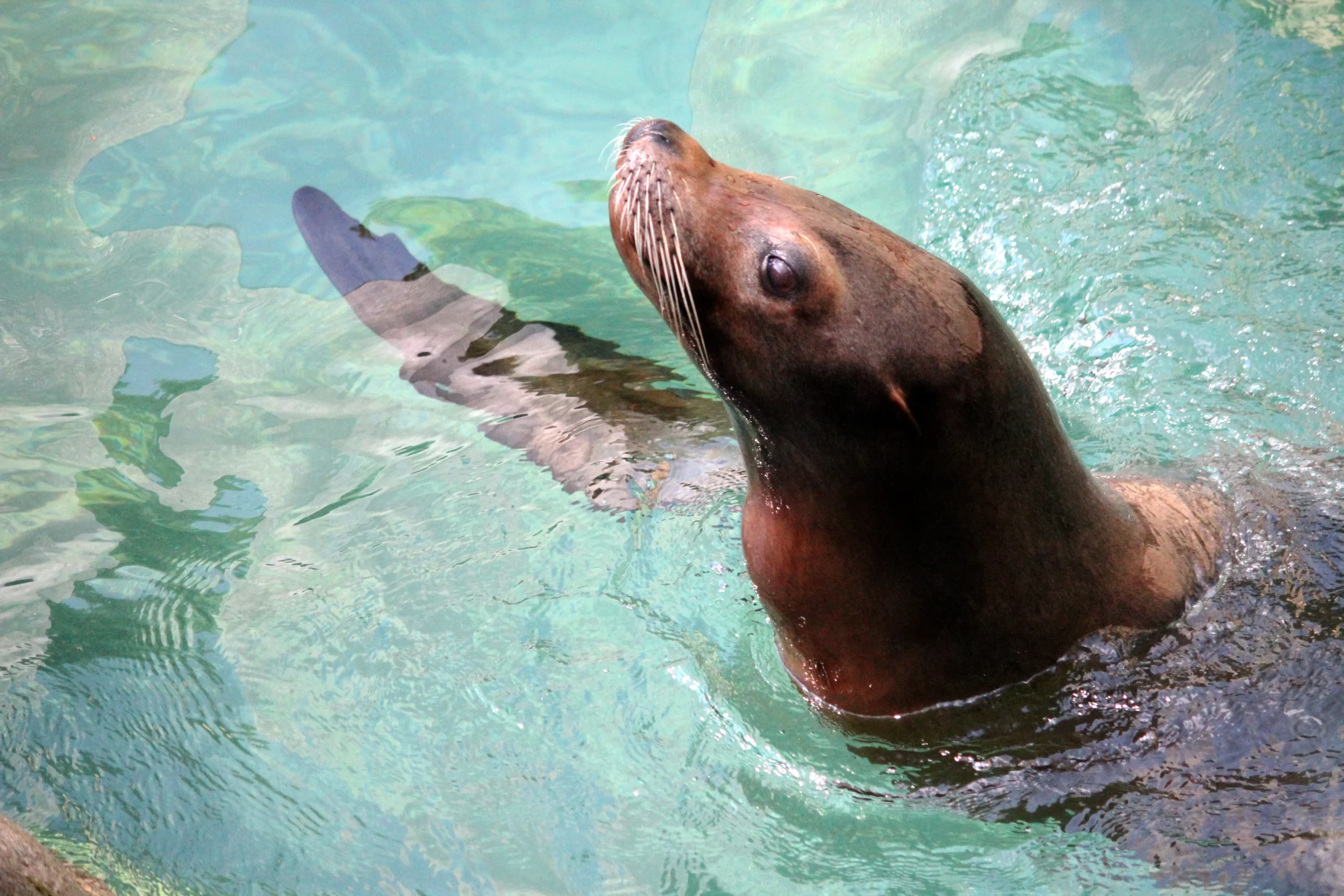
The Galapagos fur seal (Arctocephalus galapagoensis) is a marine mammal that lives naturally in the Galapagos Islands. It belongs to the family Otariidae, which includes fur seals and sea lions. Despite its common name, it is more closely related to sea lions than to true seals.
This species is particularly interesting because it is adapted to the warm waters of the equatorial Pacific. Its thick fur provides insulation, while its preference for shaded coastal areas helps it avoid overheating.
Galapagos fur seals are among the smallest members of the eared seal family. They have compact bodies, large eyes, noticeable external ears, and powerful front flippers. They spend much of their time resting on rocky shores and hunting for food in nearby waters.
The species is endemic to the Galapagos Islands, meaning its natural range is strongly associated with this archipelago. It is also considered endangered, making its protection an important part of wildlife conservation in Ecuador.
Key Takeaways
- The Galapagos fur seal’s scientific name is Arctocephalus galapagoensis.
- It is endemic to the Galapagos Islands in Ecuador.
- It is one of the smallest members of the eared seal family.
- Its thick coat helps it stay insulated in the water.
- It feeds mainly on fish and squid.
- It generally hunts at night and rests in shaded rocky areas during the day.
- Its breeding season usually runs from August to November.
- It is listed as Endangered on the IUCN Red List assessment currently available for the species.
- Historical hunting and changing ocean conditions have affected its population.
1. Where Do Galapagos Fur Seals Live?
Galapagos fur seals live in and around the Galapagos Islands, an archipelago in the Pacific Ocean belonging to Ecuador. The islands are located near the equator, where ocean currents and underwater upwelling create productive marine habitats.
The species occurs across much of the archipelago, but important colonies are found on western and northern islands. These areas provide access to productive feeding grounds and suitable coastal resting places.
Unlike animals that prefer open sandy beaches, Galapagos fur seals often choose rugged shorelines. They use rocky ledges, lava formations, large boulders, and shaded spaces between rocks as resting and breeding areas.
These locations offer several benefits:
- Shade: Rocks and overhangs protect seals from direct sunlight.
- Shelter: Narrow spaces and ledges provide places to rest.
- Access to the sea: Seals can enter the water easily when they need to hunt or escape danger.
- Nearby food: Productive waters around the islands provide fish and squid.
The Galapagos fur seal is not considered a long-distance migratory species. Its colonies are generally located close to the marine areas where individuals find food.
2. What Does a Galapagos Fur Seal Look Like?
The Galapagos fur seal has a compact body, thick coat, large eyes, and prominent external ears. It can look similar to the Galapagos sea lion, but several physical characteristics help distinguish the two.
Adult Galapagos fur seals generally have grayish-brown or dark brown fur. Their coats are particularly thick, giving them a noticeably furry appearance.
Their bodies are relatively small compared with many other fur seal species. Females typically measure around 1.3 metres long, while males can reach approximately 1.5 metres. Their weight also varies by sex, with females averaging around 27 kilograms and males around 64 kilograms in commonly reported estimates.
Other recognizable features include:
- Large, expressive eyes.
- A short, broad head.
- A relatively short muzzle.
- Visible external ears.
- Strong front flippers.
- A thick coat that provides insulation.
Their large eyes are especially useful because these animals often hunt in low-light conditions. Their front flippers help them move through the water and climb over uneven coastal surfaces.
Difference Between Galapagos Fur Seals and Galapagos Sea Lions
People sometimes confuse the Galapagos fur seal with the Galapagos sea lion because both species live on the same islands and belong to the same family.
However, they have noticeable differences.
| Feature | Galapagos Fur Seal | Galapagos Sea Lion |
| Scientific name | Arctocephalus galapagoensis | Zalophus wollebaeki |
| Body size | Generally smaller | Generally larger |
| Coat | Thick, dense fur | Shorter-looking coat |
| Eyes | Large and prominent | Generally less prominent |
| Ears | Noticeable external ears | External ears |
| Preferred resting areas | Shaded, rugged rocky shores | Often open beaches and rocks |
| Feeding habits | Mainly fish and squid | Fish, squid, and other marine prey |
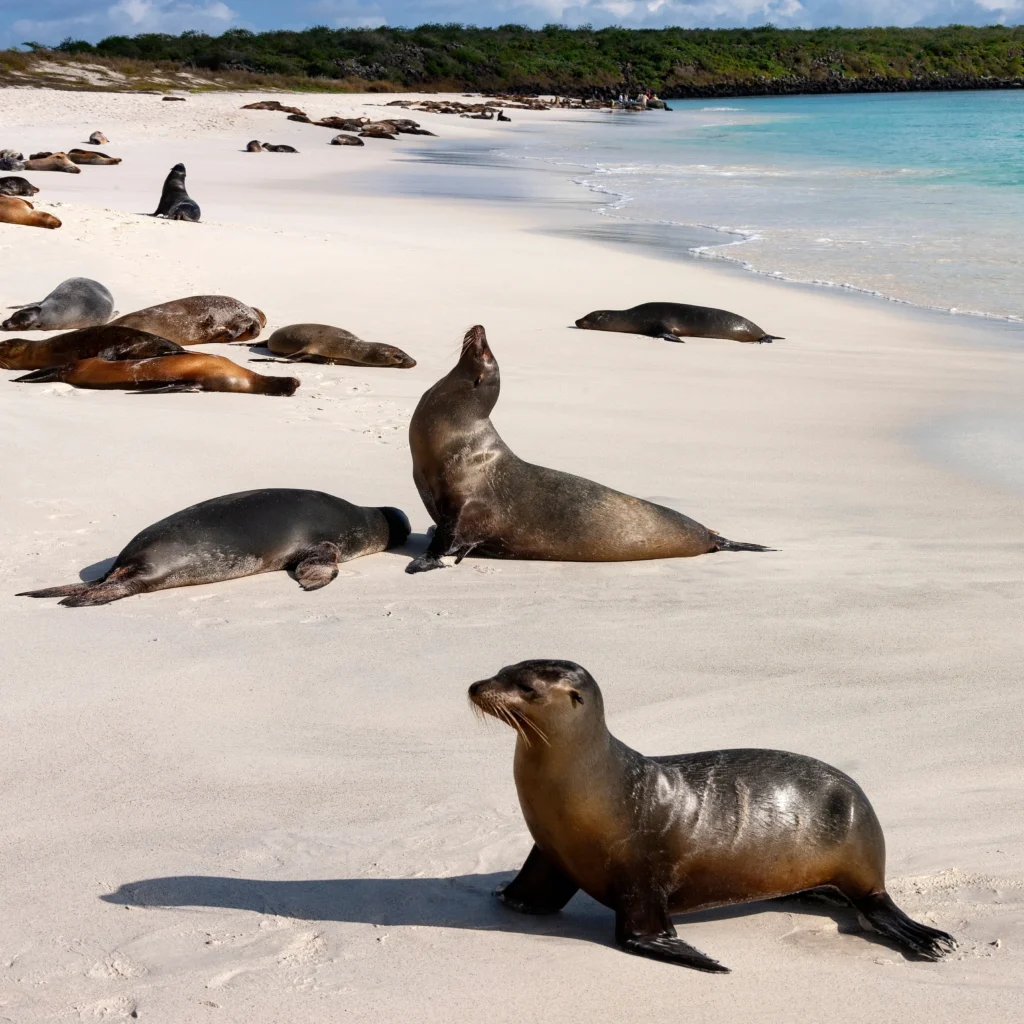
One of the easiest ways to distinguish them is by observing where they rest. Fur seals are often found in shaded, rocky areas, while sea lions are frequently seen resting on open beaches and exposed coastal surfaces.
3. What Do Galapagos Fur Seals Eat?
Galapagos fur seals are carnivorous marine mammals. Their diet consists mainly of small fish and squid found in the waters around the islands.
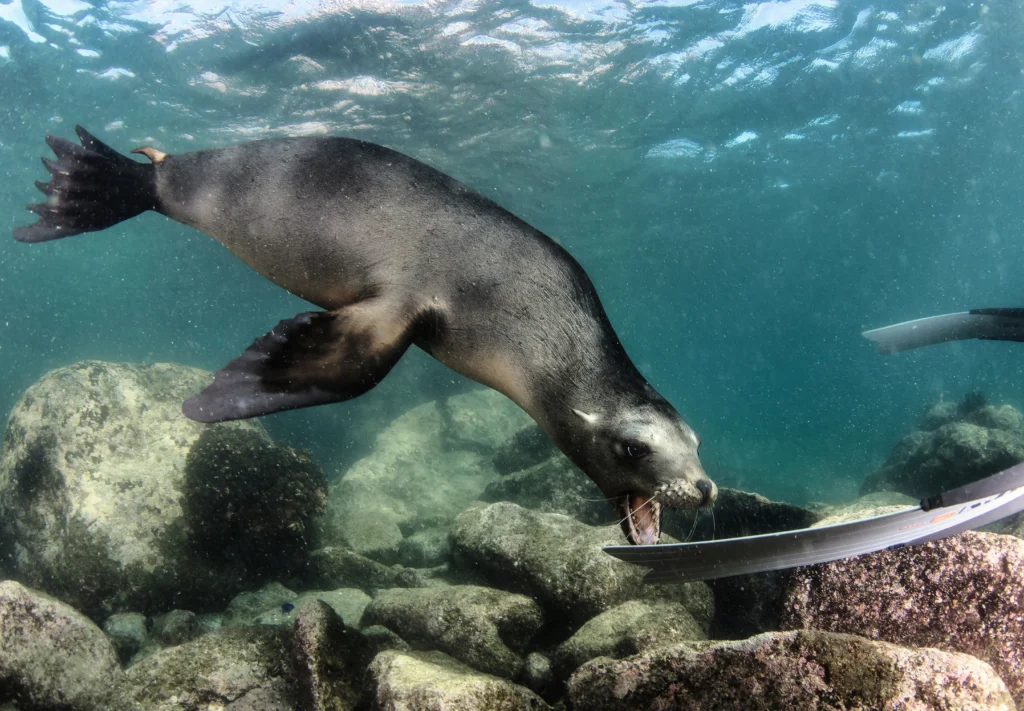
They are skilled hunters that use their eyesight, whiskers, and swimming abilities to locate and capture prey.
Common food sources include:
- Small schooling fish.
- Lanternfish and other deep-water fish.
- Squid.
- Other small marine organisms available in their feeding areas.
Their diet can change depending on the availability of prey, ocean conditions, and seasonal differences.
How Do They Hunt for Food?
Galapagos fur seals are primarily nocturnal hunters. They often leave their resting areas after sunset to search for food.
Many of the fish and squid they eat move closer to the ocean surface at night. This movement can make prey easier for seals to find.
They use their strong front flippers to swim and their sensitive whiskers to detect movement in the water. Once they locate suitable prey, they chase and capture it underwater.
Research and wildlife observations suggest that these seals generally make relatively short feeding trips compared with some other fur seal species. Their colonies are often located near productive feeding grounds.
Their hunting activity can also change with moonlight. They may reduce feeding during brighter nights, possibly because prey moves deeper or because hunting becomes riskier when they are more visible to predators.
4. Why Do Galapagos Fur Seals Hunt at Night?
Night hunting is an important part of the Galapagos fur seal’s feeding strategy.
The waters surrounding the islands contain fish and squid that move vertically through the water column. Some prey species rise closer to the surface after dark, creating opportunities for predators.
Hunting at night may offer several advantages:
Access to prey: Some fish and squid become easier to reach when they move toward the surface.
Reduced exposure to sunlight: Nighttime activity allows seals to spend more time away from direct sunlight.
Feeding efficiency: The movement of prey can create favorable feeding conditions.
Their large eyes help them see in low-light environments. This is particularly useful for animals that depend on underwater hunting after sunset.
5. How Do Galapagos Fur Seals Reproduce?
Galapagos fur seals have a breeding season that generally lasts from mid-August to mid-November. The exact timing of births can vary from year to year.
During this period, males establish territories in breeding colonies. They defend these areas against competing males and attempt to attract females.
Females give birth to a single pup at a time. Newborn pups usually have dark coats and remain close to their mothers during the early stages of life.
How Do Mother Seals Care for Their Pups?
Mother-pup relationships are essential for the survival of young Galapagos fur seals.
After giving birth, a female initially stays close to her pup. She then begins making feeding trips into the ocean while returning regularly to nurse and care for the young animal.
Mothers recognize their pups through distinctive sounds and smells. This recognition is important in crowded breeding colonies where many females and young seals gather together.
A female generally nurses only her own pup and may reject unfamiliar pups that approach her.
Young fur seals depend on their mothers for an extended period. Nursing can continue for two to three years, although the timing and success of reproduction vary among individuals and environmental conditions.
This long period of maternal care is one reason the species can be vulnerable when food becomes scarce.
6. How Do Galapagos Fur Seals Survive in a Tropical Climate?
One of the most interesting features of the Galapagos fur seal is its ability to live in a warm tropical environment despite having a thick insulating coat.
Fur seals are generally associated with cooler marine environments. However, the Galapagos fur seal has adapted to the conditions of its equatorial habitat.
Its thick fur traps insulating air and helps reduce heat loss while swimming. This is useful because water can remove body heat much faster than air.
However, the same insulation can make overheating a concern when the animal is resting on land.
To manage heat, Galapagos fur seals often choose shaded resting places. They use rocky ledges, caves, overhangs, and spaces between boulders to avoid direct sunlight.
They also spend considerable time in the water, where they can regulate their body temperature more effectively.
Their preference for shaded locations explains why visitors may not see them as easily as Galapagos sea lions. A colony can be resting nearby while many individuals remain hidden among rocks.
7. Are Galapagos Fur Seals Endangered?
Yes. The Galapagos fur seal is listed as Endangered on the IUCN Red List assessment currently available for the species.
The IUCN assessment cited in the available species record was published in 2015 and was based on an assessment conducted in 2014. It estimated approximately 10,000 mature individuals and reported a decreasing population trend at that time. These figures should not be interpreted as a current population census.
The species has faced several serious challenges throughout its history.
Historical Hunting
During the nineteenth and early twentieth centuries, fur seals were hunted for their valuable coats.
Their thick fur made them targets for commercial sealers and whalers visiting the Galapagos Islands. Historical exploitation reduced their population dramatically, and the species was once believed to be close to extinction.
It was rediscovered in 1932 after being considered potentially extinct.
Today, hunting is prohibited, and the species receives legal protection in Ecuador.
El Niño Events
El Niño is a climate pattern that can change ocean temperatures, currents, and marine productivity.
During strong El Niño events, warmer water and reduced nutrient-rich upwelling can make food harder to find around the Galapagos Islands.
This can have serious consequences for fur seals.
When prey becomes scarce:
- Adults may need to spend more time searching for food.
- Mothers may struggle to find enough food while nursing.
- Pups can become weaker or die from starvation.
- Reproductive success may decline.
Young seals are especially vulnerable because they depend heavily on their mothers for nourishment.
Fishing Activities
Fishing activities can affect marine mammals through accidental entanglement in nets and other fishing equipment.
A seal caught in fishing gear may suffer injuries, become unable to swim properly, or drown.
Fishing can also influence the availability of prey, although the impact varies depending on fishing methods, location, and local conditions.
Introduced Predators and Disease
Introduced animals can create additional risks for island wildlife.
Feral dogs have been identified as a threat to Galapagos fur seal colonies. They can attack seals on land and may also introduce diseases that affect native marine mammals.
Controlling introduced animals is therefore an important part of protecting the species.
8. What Is Being Done to Protect Galapagos Fur Seals?
The Galapagos fur seal benefits from conservation measures established in Ecuador.
The Galapagos Islands are protected through the Galapagos National Park and the surrounding marine reserve. These protected areas help conserve coastal habitats, breeding sites, and marine feeding grounds.
Important conservation efforts include:
- Prohibiting the hunting and commercial exploitation of fur seals.
- Protecting important coastal breeding colonies.
- Managing fishing activities in protected marine areas.
- Monitoring wildlife populations and their health.
- Controlling introduced predators such as feral dogs.
- Promoting responsible wildlife tourism.
- Supporting scientific research into marine ecosystems.
The Charles Darwin Foundation and other conservation organizations contribute to research and conservation work in the archipelago.
Although legal protection has helped the species recover from historical exploitation, changing ocean conditions and other threats mean continued monitoring is important.
9. Where Can You See Galapagos Fur Seals?
Visitors to the Galapagos Islands may see fur seals on rocky coastlines and at selected wildlife viewing locations.
Two locations frequently mentioned for observing these animals are:
James Bay, Santiago Island
James Bay is a coastal area on Santiago Island where visitors may encounter Galapagos fur seals resting among rocks and shaded sections of the shoreline.
Its rugged coastal environment provides suitable resting places for the species.
Darwin Bay, Genovesa Island
Darwin Bay on Genovesa Island is another well-known location for observing Galapagos wildlife.
Fur seals can be seen resting around rocky coastal areas, although sightings depend on where individual animals are located.
Best Time to See Galapagos Fur Seals
Galapagos fur seals can be observed throughout the year.
The breeding season generally runs from August to November, and October is often a good time to look for young pups.
However, wildlife sightings are never guaranteed. The animals may be resting in shaded areas or hunting offshore.
A guided wildlife excursion can help visitors identify the species while following the national park’s visitor rules.
10. How to Observe Galapagos Fur Seals Responsibly
Seeing a Galapagos fur seal in its natural environment can be a memorable experience. However, visitors should avoid disturbing these animals.
Follow these basic wildlife observation practices:
- Maintain the distance required by Galapagos National Park regulations and your guide.
- Never touch, feed, or chase a fur seal.
- Avoid blocking the animal’s path to the water.
- Do not use flash photography.
- Keep noise levels low near resting colonies.
- Never approach pups or separate them from their mothers.
- Follow marked visitor routes and guide instructions.
- Do not leave food or waste near wildlife areas.
These precautions help reduce stress and allow fur seals to continue their natural activities.
Responsible tourism also supports conservation by encouraging visitors and local operators to protect the wildlife that makes the Galapagos Islands special.
11. Why Are Galapagos Fur Seals Important to the Ecosystem?
Galapagos fur seals are an important part of the marine food web.
As predators, they feed on fish and squid, helping connect different levels of the ocean ecosystem. They are also prey for larger marine predators, including sharks and occasionally killer whales.
Their population health can provide useful information about marine environmental conditions.
For example, changes in feeding behavior, pup survival, and colony activity may reflect changes in prey availability or ocean productivity.
Because the species is endemic to a relatively small island ecosystem, protecting its habitat also helps conserve the wider biodiversity of the Galapagos Islands.
The survival of Galapagos fur seals depends on healthy marine habitats, suitable breeding locations, and effective conservation management.
FAQs About Galapagos Fur Seals
1. What is the scientific name of the Galapagos fur seal?
The scientific name of the Galapagos fur seal is Arctocephalus galapagoensis. It belongs to the family Otariidae, which includes fur seals and sea lions.
2. Where are Galapagos fur seals found?
They are native to the Galapagos Islands of Ecuador. They live along rocky coastlines and in nearby marine waters, particularly around western and northern parts of the archipelago.
3. Are Galapagos fur seals endangered?
Yes. The species is listed as Endangered on the IUCN Red List assessment currently available for it. Historical hunting, environmental changes, and other threats have affected its population.
4. What do Galapagos fur seals eat?
They mainly eat small fish and squid. Their diet changes depending on prey availability and ocean conditions.
5. How big are Galapagos fur seals?
Females are generally around 1.3 metres long, while males can reach approximately 1.5 metres. Males are usually heavier than females.
6. Are Galapagos fur seals the same as Galapagos sea lions?
No. They are separate species, although both belong to the eared seal family. Galapagos fur seals are generally smaller, have thicker coats, and prefer shaded rocky resting areas.
7. Why do Galapagos fur seals hunt at night?
Many fish and squid move closer to the ocean surface after dark. Hunting at night helps fur seals access these prey species. Their large eyes also support activity in low-light conditions.
8. When is the breeding season of Galapagos fur seals?
Their breeding season generally runs from mid-August to mid-November. The timing of births can vary, but pups are often observed around September and October.
9. Why do Galapagos fur seals have thick fur?
Their dense coat helps insulate their bodies in the water. Because they live in a tropical environment, they often rest in shaded places to avoid overheating.
10. Where is the best place to see Galapagos fur seals?
James Bay on Santiago Island and Darwin Bay on Genovesa Island are well-known places to look for them. Sightings are possible throughout the year, but individual animals may remain hidden among shaded rocks.
Conclusion
The Galapagos fur seal is a remarkable marine mammal that has adapted to life in the warm waters of the equatorial Pacific. Its thick fur, large eyes, nocturnal hunting habits, and preference for shaded rocky shores make it different from many other marine mammals.
Although the species survived severe historical hunting, it continues to face challenges from El Niño events, food shortages, introduced predators, and fishing-related threats. Protecting its coastal habitats and marine feeding grounds remains essential for its long-term survival.
For travelers visiting Ecuador, observing Galapagos fur seals offers an opportunity to appreciate the islands’ unique wildlife. By following responsible tourism practices and respecting protected areas, visitors can help support the conservation of this endangered species.